What is home? Is it the place that speaks to us? Is it family and friends? Is it culture – the language, activities and events of our lives? Or is it some delicate, indefinable balance of those three?
Then there is my friend Christina. She lives full time in her travel trailer, and home is wherever she happens to stop. Truly, she has found home within herself, in her soul.
In 1973 I drove to Bisbee for the afternoon and ended up spending the night. Within two weeks, I’d quit my Tucson job, loaded my meager belongings into my old Oldsmobile, and the cat and I moved to Bisbee. Something here had whispered to me that this was home.
I have left twice. Once I went to Montana and loved the twenty months I spent there. Then a month of thirty below zero sent me back south. Years later I took a job in Kansas City, and though I eventually learned to love it and made it a good place to live, Bisbee was always there in the back of my mind. I was desperate for the mountains, the deep blue of desert sky, and the monsoon rains. Bisbee was home, and fortunately, after a seven year absence, it took me back.
Not always so for others.
My friend Lucho fled Chile in 1974 when Pinochet’s death squads targeted him because he was the head of the teachers union. Lucho’s time was up. He got political asylum and settled in Kansas City. It was safe in the late 1980s, so he went home for a visit.
When he returned from two weeks in Chile I was anxious to hear of his trip, a little afraid we’d lose him because Chile was, after all, his home.
But no. He had not been well received. Those who stayed – and were alive to see him – blamed him for leaving. They had stayed and done battle and he was seen almost as a traitor. In their view, he should have stayed. He should have died. Then he would truly be Chilean.
Lucho knew he would never go back to Chile, that it was no longer home, and he struggled to have his uneasy life in Kansas City make do.
I met another man, a New York City cabbie. We chatted while he whisked me across Manhattan. He’d come from Ethiopia seven years previously to work and send money home so his siblings could go to school. He’d hoped to be here only a few years, and he’d actually accomplished his goal.
“Why haven’t you gone back?” I asked.
“I did. It wasn’t the same. I wasn’t the same. It was no longer home.”
“So now New York is your home?”
“No. I am not really a New Yorker. I no longer have a home.”
Category Archives: Uncategorized
Hike to the Bisbee Shrine
Today I did something I should have done long ago. I hiked up to the shrine high above Bisbee’s Brewery Gulch with friend Cinda. It’s a fairly long climb that starts in the Gulch, heads up some stairs, cuts briefly up a sort of road, and then moves into lots of loose shale.
I didn’t think to bring my walking stick, so for me, with poor balance due to head injury, it was a serious challenge, and I won’t do it again without a stick.
This was a repeat climb for Cinda who’s been there numerous times. She climbed up there once at night, using a flashlight, and spent the night. I am not that crazy. But she was the perfect guide since she knows the trail well.
The shrine was built in 1980 by Adolfo Vasquez. The story is he promised God he’d build a shrine if God would let him keep his sight. God did, and Adolfo did. He maintained it lovingly over the years until his death in, I believe, 2000 at the age of 84. These days it is not so well maintained.
Also, others have decided to put their own shrines both there and just downhill from the Vasquez shrine, so there’s a lot to see up on Chihuahua Hill.
Here’s today’s hike in photos.
The hike began on stairs. Shortly after I took this photo, a young man came jogging down, hopped onto the rail to the left, and slide the last 200 feet or so.

A nice datura plant.

The stairs get a little worse.

The view from about halfway up.

Now the trail really deteriorates.

Almost there!

One of the newer shrines below the original Vasquez shrine.

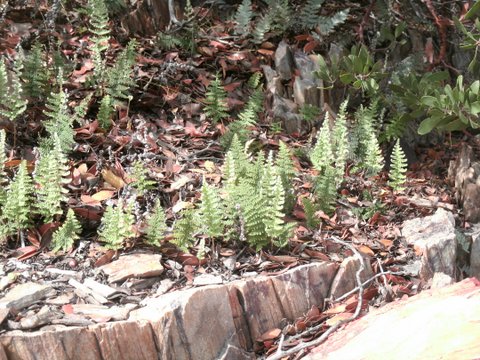
A miniature fern forest. These little ferns ranged from two to four inches tall.
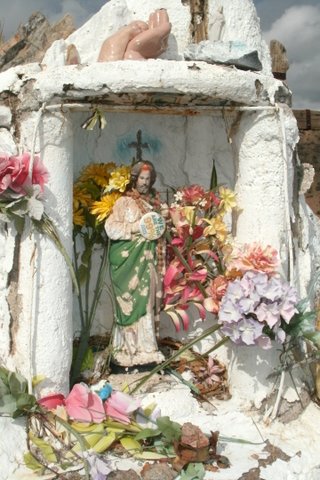
The Virgin, just below the shrine.

A little memorial to Ezekiel Hernandez, shot in 1997 by Marines who were assisting the Border Patrol Ezekiel was herding his goats and carrying a rifle. Ezekiel appeared “dangerous” I suppose. He was 18 years old.

Finally, the shrine.

The button in the photo below reads We are the 99%.”
The view into Bisbee from the base of the shrine.

We stayed awhile, recouped from the hike up, and headed back down. My legs were a bit shaky, and it was rugged at times on the shale, but we both made it down intact. I encourage you all to try this hike. Worth it, for sure!
Guns
On the news this morning, the CEO of Cinemark called the shooting in Aurora, Colorado, an isolated incident.
Isolated? The mayor of Toronto said the same thing just last month when a gunman shot several people in a mall. The same was said last year in Arizona after Congresswoman Giffords and others were shot in front of a Safeway in Tucson.
In fact, Colombine and every incident since then has been called “isolated.”
On top of that, at every mass shooting, area residents have said they never expected it to happen “here.” Well, clearly, here is exactly where it happens.
But why? How is it friends, relatives, and neighbors don’t see that slow burn that leads up to such a shooting?
Of course there are copycats. But what drives the desire to cause such mayhem and tragedy? I think it comes down to two things.
First, there is a level of violence in our media today that is unprecedented. Violence is on the news every night. Many of the new release movies have strong levels of violence. And of course there are video games.
Now, the majority of people who see the news, go to a movie, or play a video game are probably not likely to become a mass murderer. But some are.
Combine the violence in the media with the hate spewed on some radio and TV talk shows, and we have a heady mix for someone on the edge. I wonder what presets the police will find on the car radio James Holmes drove to the theater in Aurora. And if they could get to his computer, I’d bet they’d find he explored many of the sites Jared Loughner, the shooter in Tucson last year, had been searching.
Some would say we need to monitor people’s web activity. I surely won’t go there though I do understand the sentiment. But surely someone noticed a change in behavior, a threat, some kind of motive.
Are we all our brothers’ keepers? In a sense, we are. We need to notice when someone’s behavior changes, when the mood darkens. And I think it is way past time for Hollywood and video game designers to consider their culpability in these acts of violence.
Second, of course, are the weapons themselves and the organizations that champion them. I am not at all anti-gun. However, are we making our country safer by allowing them to get so easily into almost anyone’s hands?
To drive a car – a deadly weapon in some senses – we have to study, practice and receive a license. To buy and use a deadly weapon, we have only to drop by a store or gun show, or simply click the button on the internet.
Why is there not a master list of who is buying what kinds of weapons? Loughner was known to be unstable, so if his name had popped up on a list indicating he’d tried to purchase an assault weapon, just maybe his murderous spree could have been prevented.
I know the constitution gives us the right to own guns (and I own one), but it doesn’t say that gun purchasers shouldn’t be background checked. It also doesn’t say anything about weapons designed solely for assault. We can’t (legally) to buy rocket launchers and nuclear bombs – other weapons of mass destruction – so why assault rifles?
The weapon James Holmes used in Aurora was banned in 1994. Largely in thanks to the NRA and gun lobby, the ban expired in 2004.
One day, at an NRA convention, some member on the edge could walk happily into the convention, one of many carrying an assault weapon. Smiling. He could then open up and shoot and kill fifty or sixty people.
And because the room would be full of righteous second-amendment-believing gun-toting good Americans, three quarters of the room would stand up and shoot back at this madman. And then how many would die.
Only then might the membership change their stance.
I Come From . . .
Today I started a new writing group with a facilitator who provides prompts and support. One prompt, with a brief period of time in which to write, was “I come from . . .” and here’s where it went.
I come from Illinois. From an educated mother raised and hating small-town Pennsylvania. From a father who flip-flopped between Chicago and a small town in Indiana he loved.
I come from a deep respect for education and reading and grammar. Yes, grammar. My mother, an English major, insisted on it as did my father who worked hard to move from poverty to slightly upper middle class.
I come from a childhood of freedom. Freedom to run and play with little adult supervision. Freedom to create – plays for the neighborhood each summer, go-karts, and lemon pie. And freedom to dream. As long as those dreams were appropriate to girls.
I come from restriction and repression. Go-karts were fine when I was nine. Not fine when I was thirteen. Dreams of building houses were encouraged when I was a child. Squashed when I was an adolescent. Freedom to explore became freedom to choose one of just a few life tracks “approved” for females.
I come from rebellion. How could I not? I am, after all, a child of the sixties. The magazines I was encouraged to read as a child showed me a world far wider than suburbia. The nightly news showed me injustice I felt compelled to struggle against. My parents showed me a lifestyle I chose to toss away.
I come from teenage escapes to the city. To folk music and the blues. To drinking wine while sitting on the sidewalks of the near north side. To the end of the beat generation and beginning of the hippies.
I come from a ride across the country in an old hippie bus, from parents with looks of worry and concern as I left.
I come from raspberry patches, a backyard garden and ice cream every day.
I come from nearly fifty years of work to the blessing of retirement. If only I had fifty years to enjoy it.
An Odd Day
The itinerary told it all: it would be an odd trip. Louisville to Phoenix via Detroit City. Made me want to sing some Motown.
My flight from Louisville was at 8, so my brother-in-law got me to the airport a little before 7. I checked my bag curbside, no line, and proceeded to security, also no line. I tossed my bag and shoes into the plastic tub to send them through the scanner. Walked right through the metal detector. That’s when the fun began.
“Got a random,” shouted the smiling man. Now, I have been called many things in my lifetime, but a random?
I was sent to a secondary security checkpoint where I expected to be gone over with a wand or sent through the machine that allows someone to see me naked. But no. A nice woman approached me clipping a little piece of fabric onto what looked like a small rubber mallet. She had me hold my hands palms up and told me I was being swabbed for traces of explosives.
Ah. A random explosives check.
When I told my sister what had happened, she said she was glad I was out of the house. Just in case I really was a secret explosives expert.
Boarded my flight to the north country and settled in. We got there in plenty of time but had to hover over the airport awhile due to storms. As we landed, the sky was thick and dark and I couldn’t see the ground until we’d almost touched down.
I deboarded and found my next gate. Merely steps away! When I land in Dallas, I usually have to hop the train and cross two time zones to get to my next flight, all in the space of forty-five minutes. But there I was in Detroit with a nearly three hour layover and had to spend only a minute to get to my next gate.
I walked the entire A terminal, which must have been close to two miles round trip, and settled in for a nice lunch before my flight. It was a nice lunch, but with the world’s worst waitress. I left the poorest tip I have ever left, and almost left none.
When I got to my gate, we were told our flight would be delayed as the plane had not yet arrived. Although it arrived a short time later, there was then trouble with the boarding ramp which men spent half an hour trying to fix. The plane was finally moved to a different gate where we boarded over an hour late.
This meant I would miss the Phoenix-Tucson shuttle and would get to Tucson an hour later than I’d planned.
I had a beer on the plane once it finally got off the ground.
I’d made Long distance arrangements to change the time I’d catch the shuttle, so of course when I got to the shuttle check-in, the van was just loading and I got on, which meant waiting an hour on the Tucson end for my ride there.
Most interesting part of the day? In the Phoenix airport, I saw a quite burly man with arm, neck and leg tattoos. He was wearing a skirt.
Banámichi and North
When I left Kino it was 76 degrees and drippingly humid. One hour inland it was 97 and bone dry. It was still dry when I got to Banámichi, but at least it was cooler.
I’d driven up the southern end of the Ruta Rio Sonora. With such a fine name, you’d think the road would be good, but you’d be wrong. Parts of Sonora 118 have been repaved in the

last few years, but others seem to have been ignored for a decade. 118 is narrow and twisty, but there are many places to pull over. Beautiful views of the river valley and of redrock cliffs.
I pulled into Banámichi around 4:30, hoping Hotel Los Arcos would have a room available, and it did. Costly. A splurge. But it was lovely and as a bonus, there was wi fi.

My spacious room held a comfy bed. The bathroom had plenty of hot water and plenty of water pressure – both rare in less expensive places. The bathroom vanity was made of a 2″ slab of mesquite and held a talavera sink.
The ten rooms at Los Arcos surround a courtyard full of potted plants, cozy sitting areas, and small ponds. The perfect place for a book and a cold beer at the end of a hot day.
I took my things to my room, spoke briefly to owners Lynn and Tom, formerly of Colorado, and went for a walk. Evening was falling, so shadows were long and late sunlight intensified colors.

I found Banámichi to be a mix of buildings that have been maintained, beautifully restored, or abandoned. I strolled about twelve blocks, taking in the sights and sounds of supper time in small town Sonora.
Back at Arco Iris, I settled into a chair in the courtyard with my Tecate. Two Canadian miners nodded at me as they left their rooms and headed out for the night shift drilling core samples in a quest for gold and silver. Word has it the Santa Elena mine is pulling out plenty of both, netting a nice profit for SilverCrest Mines, Inc. The miners went to work and I sat outside until long after dark.
The night was stunningly quiet. An occasional car rumbled up the street. That was it. Even the cars stopped by eleven or so. And then silence. Delicious silence.
Breakfast the next morning in the courtyard. Leisurely.

Then it was time to head north. Past small towns, slowing for the topes on both ends of each pueblo. Through dips, some deep. Some had warning signs reading Vado Pelegroso, dangerous dip. Take that sign seriously if it’s rainy season. The vados on Sonora 118 are often tributaries to the Rio Sonora and can run fast and deep.
One other thing about this highway: the only bridges are foot bridges. You won’t drive over the river; you’ll drive through it. The road is simply not passable during rainy season.
As I headed north, I stopped a few times to take in views and made one longer stop just north of the village of Arizpe to wade the river. I saw an egret searching his breakfast and tried to sneak up on him with my camera. Through the river, down an embankment and up to a barbed wire fence. Then I walked the fenceline until I was in the perfect position. And he stepped into the bushes. Deciding he was camera shy, I went back to my car.
Three hours after leaving Banámichi I was in line at the border. Familiar faces greeted me, noted the luggage and cooler in my car, and asked where I’d been this time.
Well, Kino, of course!
Of course, they responded. Of course.
A Mind Twisting Day
I left Kino around noon with two main goals: visit the Home Depot in Hermosillo to price some materials, and to then cut east and return via the Rio Sonora without getting stopped by the cops.
Home Depot seemed easy. The Rio Sonora route, not so much. Technically, US cars need a Mexican permiso to drive this route, and I don’t have one. They cost about $40 and require a $300 deposit that isn’t returned until you turn the permiso back in, on time. Not turned in? You can never get another one. Late? Well, you can get another one some day, but you forfeit the $300. So, big goal. No cops.
But then life happened.
A friend had told me the Home Depot (henceforth the HD) was right across from the Wal-Mart (WM). I cruised up and down, round and round. I almost pulled right out in front of a car but his angry car horn stopped me dead. I circled and searched. Finally, I pulled into the WM parking lot (I SWEAR I didn’t go in!!!) to try to find someone who could tell me where the HD was.
My luck! Along came a taxi cab. I flagged down the driver and he told me it was across from the other Wal-Mart a few miles south. Turns out I had driven within a block of it before turning around and heading back north for miles.
I zipped down to the HD, parked, and went into the store. Such convenience! It was laid out just like the ones in the states, so it was easy to find my way around and check the prices.
As I wandered the aisles, Stevie Wonder crooned through the store speakers telling me he’d just called to say he loved me. I was touched. In honor of a friend who loves to dance, I did a a little jig down the plywood aisle. A few people backed away.
Got my prices, wrote them down without fainting, then back to the car to head back north to make my way around to the highway that runs from the north along the east side of the city. Then it struck me: I would just have to go way north and then east and then back south. Why not just cut through the city and get to the highway? Heck, I had a MAP! I was fearless.
Well, not quite fearless. I remembered the last time I’d tried to find my way through Hermosillo. I left a friend’s house around 2:00, and an hour later, I found myself circling back past her neighborhood. I’d gotten myself caught in one of the city’s many loops.
I called her on my Mexican cell phone, got good instructions, and headed back out. An hour later, after wandering downtown,driving twice the wrong way on one-way streets, and circling awhile in a new suburb, I finally emerged onto the highway back to Kino.
The one hour and fifteen minute drive took me only three hours.
But this time, I had a MAP!
I pulled over and laid out my route. Easy. Follow Johnson to Rodriguez to Kino to the highway. A snap. Fifteen minutes max.
I couldn’t get to Johnson directly and got lost in a neighborhood. I finally made it but almost missed it because it was labeled as Encinas, the whole name being Bolevard Luis Encinas Johnson. I never found Rodriguez (Alberado L Rodriguez. Had it just been called “L”?)
An hour later I was almost out of gas and had made likely the most circuitous route possible to the highway. But I made it. I snarled when I drove past my friend’s old neighborhood and didn’t dare call her to tell her I’d done it once again, but with a MAP.
Got gas, found the highway east and headed toward the Ruta Rio Sonora. Wow!
Four miles down the road I landed in the wrong lane, missed a road entrance and had to circle under a bridge, drive back west a mile or so and try again. Success.
Now. Why had I planned to take this route? It is longer and it is much slower than my usual over-the-mountain trek.
Well, my tires are old and warn. I didn’t want to take that white-knuckle mountain road. Knew that it could be more dangerous than it usually is to drive it with old tires.
So. I cruised east on Sonora route 14. A lovely drive past ranches and small villages. Men on horseback rode along the side the road. Many little towns had signs pointing the way to the molinero, the wheat grinding facility. It was rural and rustic, a Mexican blue highway.
And then it changed. It began to slowly climb uphill. Then it began to twist through the hills. Oh, NO! Exactly the situation I had wanted to avoid!
But it wasn’t nearly so bad as the old white knuckler. This road was a bit wider, and it wasn’t anywhere as steep as the other. Also, there were several wide spots where it would be easy to pull off if necessary, and on the road I’d been avoiding, those spots are few and far between. Plus, there were no mind-numbing sheer cliff drop offs with little roadside crosses planted every few feet. And another bonus, no big trucks.
So, though I initially feared for my life when I saw the rise in elevation complete with twisty road, it was fine.
In about 70 miles and closer to two hours than one, I found the road north, the actual Ruta Sonora.
I drove lazily, letting my eyes wander over green fields and beyond to the string of cottonwoods that gave away the river’s location. I thought about stopping a few times but figured with my luck a kindly cop would stop to see if I was okay. And then he’d become a little less kindly once he noticed I was without a permiso. So I plodded on.
And then it happened. In the first big town, Baviacora, a kindly cop watched me drive by. He was sitting at a stop sign on a cross street. And he then zipped in behind me.
First concern was there was no posted speed limit, so I was sort of winging it by cruising at about 22. Second concern, of course, was that he’d noticed the lack of permiso on my car windshield.
He clung to my back bumper. I kept driving an even 22. He stayed on my bumper. About a mile later, he turned off. Success! First kindly cop either ignored or missed my lawbreaking.
On to Banamihci!
Spirit
-
According to William Powers, in his book “12 By 12,” kids today can identify around a thousand corporate logos, but most can’t identify ten native plants and animals in their area.
Whew.
The number seems high to me. A thousand corporate logos? My initial reaction was, “But there aren’t that many!”
But of course there are. And many more.
I wonder how many I could identify. Too many, most likely. But thankfully I can identify many, many native plants and animals.
Of course most kids cant identify native plants and animals. Today, kids spend way too much of their time inside. Sleeping, eating, TV. Computers and video games. School. Church if they do that.
Long ago, I don’t even remember when, I realized that the desert was my church. When I need to get close to whatever Spirit it is that I connect with, I go outside. I can find it inside, too, but I believe Spirit lives outside.
One if the earliest deeply spiritual moments in my life was in about 1977 or 1978. I was standing at the rim of Canyon de Chelley in northern Arizona, and suddenly I was filled with, well, whatever it is.
It wasn’t that I hadn’t ever been to church. I had been raised attending church, celebrating Christmas and Easter. I’d attended summer church events and church camp. But what I liked most about church camp and summer events was being out of doors. That is where I found peace, where I found myself, and where I found the earliest stirrings of Spirit.
Then, that summer at Canyon de Chelley, I can’t even express what happened. I just felt deeply that there was a living Spirit In me. It emanated from the Earth and had nothing to do with the God I’d heard of my whole life. It stirred something in me, and that stirring has never gone away.
More recently, I had the experience of leaning out of a little boat, a panga, on a lagoon in central Baja California to stroke the back of a gray whale. Spirit was there again.
In fact, I felt it as soon as I saw my first whale breaching. I knew it was pure goodness, pure Godliness, pure Spirit. Touching that whale, looking into her huge eye, moved me in a way nothing else ever has.
I met Spirit in Guatemala on a boat while crossing Lago Atitlan, and met Her again when hang gliding, jumping off a 7000 foot cliff in southern
Arizona to circle with hawks.
Of course, it doesn’t take a whale or a hang glide to experience Spirit. She was there today as I sat on a sand bar and looked at the sea. In December, Spirit glimmered in the face of a dead sea turtle. The other day She was in a saguaro blossom.
All of my encounters with Spirit have been outside. It’s not that She won’t come inside. Of course She will. But Her home is in nature.
So. What are we letting happen to our children? When we confine them all day in classrooms, cut funds for field trips, and cut back recess time so kids can do better on mandatory testing, what are we doing to their psyches? How are we interfering with their spiritual development?
I believe in the separation of church and state. But Spirit is not church. She just IS. And She is earth, sea, and sky. She is nature. She is not in a corporate logo.
This is not something I can prove. I have no evidence. I have only the edge of a canyon, a dead sea turtle, and the eye of a whale to tell me it is true.
Blue Highways
I’m reading a book I wish I’d read thirty years ago: Blue Highways.
I love the blue ones, and last time I drove to Louisville, I took the blue highways most of the way back to Arizona. Slower, to be sure, but beautiful, and remnants of a time gone by.
I wish I’d read the book thirty years ago because I would like to have driven the same route as William Least Heat Moon.
In fact, I’ve driven many of the roads in his book. I’m just now half way through the book and am astounded at the towns he drive through that I, too, have driven through. I even have taken some back roads he missed.
One town that jumped out at me as I was reading was Scooba, Mississippi. Two years ago, I drove through Scooba. That’s the town I stopped in and bought the Very Best Barbecue Ever. “J’s BBQ, best in town,” says the sign. Heck. Best in the nation.
The big difference between Least Heat Moon’s drive and mine is the thirty year difference. Many of his blue highways no longer exist. He talked about the highway through Scooba being a road, a blue line on a map. When I drove it, it was a four-lane divided highway. Wish I’d seen it the other way, but then, of course, J’s BBQ wouldn’t have been along the side of the road. It’s not likely any black man’s food stand would have been along the side of the road.
Another difference is the food. The author spoke of searching for six-calendar diners. His theory is the more calendars there are on the walls of a diner, the more authentic it is. The problem is today there are few diners. Whenever I run into one, I stop, even if I’m not hungry. I just get food to go.
Evert time I go into a place because it looks cute, it’s a mistake. The food, if I’m lucky, is average. It’s the little diners, the ones lined with locals’ trucks, that are always the best.
One of my best meals ever (besides J’s BBQ) was in rural Oklahoma on a blue highway about thirty-five years ago. I was on my way to the Chicago area, staying off the interstates. I stopped somewhere west of Oklahoma City. My car steered herself right into the parking lot. I no longer remember what it is I ate there, but I recall telling people about it for many months to come.
Even in Kino, I prefer the little stands or the restaurants that cover open air patios with tarps when they’re closed. Sometimes the food is average, but more often than not, it’s excellent – and half the price of the “nice” restaurants. Some of the best places in Kino don’t even have menus. You just tell the waitress/waiter, often a child, what you want or ask what they’ve got. I go for the first thing they mention.
One of my best meals on the whole Baja trip was in a tiny restaurant in which the owner, an elderly man, was cook, waiter, busboy and dishwasher. Oh, that chicken mole! (MOW-lay, not mole, the animal)
Least Heat Moon talked, too, about his time in Selma, and though I was there probably the same year he was, my experience was completely different. He met white folks with resentments over things changed. The shop owner I spoke with seemed to have appreciated the march and the changes it created. Of course, perhaps she was being polite to the Yankees who dropped into her store, but maybe, I hope, she was being honest with us.
One thing I don’t do and couldn’t have done then is enter the little bars with the ease Least Heat Moon did. A strange woman walking into a bar in rural towns wasn’t appropriate, and sometimes still isn’t. In rural Mexico, there are ladies’ bars. They’re a little more upscale than the raunchy bars local men hang in, and the name implies they’re safe for women. The closest thing to a lady’s bar in the US might be a modest bar attached to a hotel. In one-bar towns, unless I see women walking in alone or in small groups, I’d stay out.
The last big difference is a difference of the times. Least Heat Moon picked up several hitchhikers. I used to in the 70s and early 80s, but no longer. Around home I do, often because I recognize the person or couple, but on the road, alone, no more.
Ah, the blue highways. I’m ready to get on the road.
Return to Kino
Riding down to Bahia Kino with Pam, our clothes, books, and food in the back of her truck, wedged in with a washing machine.
Past Imuris and Magdalena, across the low Sonoran desert and into Hermosillow. Past the carnecerias on Soledad and to Santander, the bank where we are charged no fee to withdraw pesos with our ATM cards. Past the town called Calle Doce and finally, we can see Isla Alcatrz in the distance. That’s when we know we’re home.

We pull into Bahia Kino and then to Islanda where our trailers are. Pam pulls up to my little trailer, the one I share with two others, and there is the sea. I smile, jump from the truck, and wham! Bobitos!
I’m assaulted by swarms of the no-see-ums that thrive along this coastal area in springtime. Except you can actually see bobitos, so I suppose they don’t technically qualify as a no-see-um. And thankfully, unlike their cousins that come out in Bisbee during rainy season, bobitos don’t bite. But they are everywhere, and on this day, they were the worst I’d ever seen.
In my eyes, up my nose, and in my ears. And of course, because I have to keep opening the door to carry my things into the trailer, soon my trailer is abuzz with bobitos too.
A friend here has a room that is mostly screened. She also uses a mosquito coil and keeps a ceiling fan going, and with all of these in her favor, there are few bobitos and she can sit outside. My patio is open, and though a nice breeze moves through it, it’s not enough to keep the pests at bay.
Day two. I rise early, watch the light spilling over the sea. I take my morning walk with a few friends, stopping for coffee at our favorite little restaurant where the proprietor greets me with a hug, welcoming me home, telling me it’s been way too long since I was here. We sit with our coffee in his open air restaurant, thankful that the bobitos aren’t out this early.
Strangely, when we get back to Islandia, the swarms of the nasty bugs aren’t around.
There are a few, and they remain all day, but it is actually okay to sit outside in the evening to drink a beer with friends. There are bobitos, but not many.
Where did they all disappear to in one day? Is it the end of their season? Is it my presence that struck fear into their evil little hearts and made them leave? Whatever the reason, I’m delighted to know I can roam the beach, sit on my patio with coffee, and attend tonight’s pizza party without fear of the swarms.
That’s right, pizza party tonight! I was here last fall when the autumn party was held, and the spring fiesta is tonight. Fresh pizza, handmade dough, a perfect assortment of toppings, and the pie baked in an outdoor wood-fired oven. To celebrate, I’ll make up a big batch of guacamole and bring along a Negra Modelo.
A perfect ending to a perfect Kino day.
 Emilie Vardaman