Turtle Dance at the Taos Pueblo

Christina and I went to the Taos Pueblo today to watch the Turtle Dance. It is a sacred dance and no cameras or cell phones are allowed on site all day.

I’d learned that the dances begin either at dawn, at 8, or at 10. We decided to be there by 10, because even if they started at dawn, they’d still be going on, and the day would be a bit warmer. We parked, leaving purses and cameras in the car, and walked onto the plaza area. Off to the side a dance was under way, having started immediately after the pre-dawn church service.

The dance was done by a line of men, all of whom were bare-chested in the 18 degree morning. There were about twenty-five in the line, and at each end was a boy of maybe age nine or ten. The rest of the dancers were all ages, up to perhaps middle to late sixties. They were all dressed in a similar fashion.

The men wore dark shoes, maybe moccasins, and had fur around their ankles. They all wore white leggings, some with black dots all over them and some with other designs. I read on-line that they are crocheted.

Each man had fabric wrapped around his waist, held in place with a colorful sash. Most of the men wore white fabric decorated, usually, in red, green, and black, but four of them wore black fabric with red and white designs.

The fabric simply fell from the waist in front, but in back I could see one or more colorful sashes, and there was another  separate fabric hanging from the waist, about a foot wide and eighteen inches long. Each piece was different and colorful. In addition, many men had the pelt of a small animal tucked into the waistline, with the animals’ tails hanging nearly to the men’s ankles.

Each man carried a white rattle in his right hand and a sprig of pine in his left. Rattles, at the end of a wooden stick, were painted white and appeared to be the size and shape of a small turtle shell. Some men wore a white necklace or a piece of leather with bells as a bandolier.

Each man had a similarly painted face. The paint was a white stripe, beginning under the ear, running down the cheekbone and across the chin, then up the other side to the ear. Some stripes were pure white and others were subtly decorated, mostly by having spots of less paint.

The head and hair were decorated also. The hair was pulled back but not visible due to more fabric at the back of the head. On top of the head were small boughs of pine with a cluster of brown and white feathers. Standing up from the head was a feather, usually orange but sometimes turquoise, likely parrot feathers. There were two tall brown eagle feathers also, and an occasional man had two brightly colored tall feathers.

In addition to the dancers, there were four other men: one, perhaps an elder, was dressed in black head to toe, topped with a black tunic belted at the waist. Pine boughs were tucked into his belt. The elder danced back and forth in front of the line of men. Two others were also in black, and one was the drummer. They all sang except for the two young boys – likely their voices weren’t deep enough, but there are probably other reasons for their not singing.

The dance and chanting went on for fifteen or twenty minutes. Then they’d stop and walk in a line to a different spot and begin again. The crowd followed along behind.

In addition to the many visitors, women of the pueblo watched the dancing. Some joined the crowds, their long skirts swaying side to side as they walked. Rather than wearing jackets, they had blankets draped around their shoulders. A few women stood on the flat roof of their home to watch.

This was an intensely beautiful and spiritual time for me. I longed to have photos, but I surely understand and respect the tribe’s desire to not allow them. I felt honored to be allowed to watch.

The photo below is not mine – remember, cameras were not allowed. It’s from http://www.newmexico.travel/dev/native_american/pueblos/taos.php

505-taos-pueblo-in-snow

North to Taos

After a wonderful breakfast in a French café with a friend, I headed out of Santa Fe, taking the back-road scenic route to Taos. Past places with names like Peňasco, Chimayó, Truchas. It is a gorgeous drive.

On the road north of Santa Fe.
Along the same road.


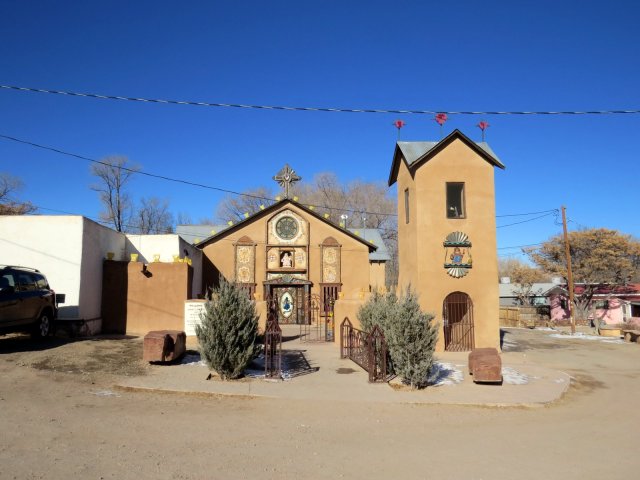
My first stop was Chimayó, a village over three hundred years old. Chimayó is a place long believed to be the site of miraculous healings at the spot a wooden crucifix was unearthed. Because of the healings, a small chapel was built in 1816, called el Santuario de Nuestro Seňor de Esquipulas. Today it’s more simply called el Santuario de Chimayó, and thousands come each year to be healed.

el Sanctuario
el Santuario
Local color.
Local color.

During WWII. Many New Mexican soldiers prayed for safety to Santo Niňo de Atocha. A chapel dedicated to this child saint, constructed in the mid-1800s, is also in Chimayó.  When the soldiers returned from the war, they began what is now yearly walk to Chimayó at Easter to thank the saint for his protection. In the days leading up to Easter, each year the roads and trails heading to Chimayó are filled with thankful believers. This is something I hope to return to see and maybe participate in one day.

I first stepped into the Santa Niňo de Atocha Chapel.

the Chapel
the Chapel

It is small, serene, and sacred. The thick adobe walls keep outside noise from entering. I sat awhile, then approached the front and entered the prayer room. There were photos of maybe two thousand children who have died. Tiny shoes were tucked onto bancos and ledges. Candles burned.

beautiful entrance to the Chapel

Although some of the photos and shoes belonged to pre-teens, most belonged to babies and infants. It was heartbreaking. I could think only of the children massacred in Connecticut, and returned to the main chapel to pray for them. And to weep.

I sat awhile, then left to roam the tiny village, stopping next in the Santuario. It, too, feels like a sacred place. Again I sat, and again I entered the prayer room. Off to the side of the prayer room is a tiny room with a hole in the floor where people can take a bit of the holy dirt. Although I didn’t take any, I reached into the hole, scooping up dirt and letting it trickle through my hands.

Then I roamed the outside and visited galleries both in the village and just outside the village.

in the gardens of el Santuario
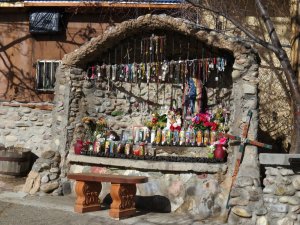
A shrine to La Virgin.

Photos are not allowed inside the Santuario or the Chapel,which is why none were included. Here are photos from the area. This is a visit I recommend each of you take one day.

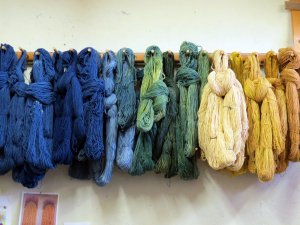
In a weaving studio on the road north of Chimayo.
near Truchas
near Truchas
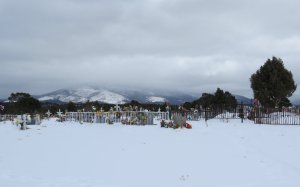
Cemetery
Cemetery
outside Truchas
outside Truchas
into the Taos valley
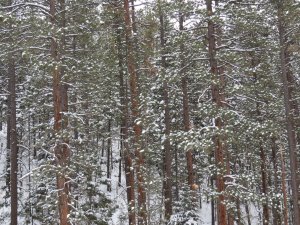
the snow on the pines looks like Christmas decorations

IMG_0365

Gallup to Santa Fe

After spending a comfy night in an old Route 66 motel, I went out to find Lucille had been snow-dusted overnight. Then, I had to relearn how to walk on black ice. Scary stuff!
Lucille meets snow.
Lucille meets snow.

I took off in the morning gray and was delighted that the highway was in good shape. Cloud cover was thick, and dawn gave little light.

IMG_0288

Then, a truck passed me and flipped dirty slush onto my windshield. I hit the wipers, but it was so cold out it froze into a blur. Tried the wiper fluid, but the slush must have frozen them shut. That’s when the sun chose to burst through the clouds and hit my windshield dead on.

I was blinded! Zipping down the highway at 65, and I was unable to see a thing. I braked, turned on the flashers, and watched the white stripes next to me for guidance. I couldn’t pull onto the shoulder – it was solid ice.

I’d slowed to maybe 35 when the road began to curve, and the sun no longer hit the windshield in the same way, so I could see. Sort of.

Thankfully there was an exit ramp in about a mile. I took it, pulled over, and threw snow on my windshield while using the wipers. Finally got clean glass. That sudden inability to see a thing is probably the single scariest thing that has ever happened to me while driving.

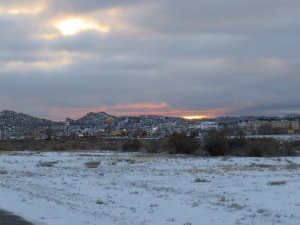
From where I cleaned my windshield.

Then – on to Santa Fe, no other incidents. The scenery on I-40 between Gallup and Albuquerque is beyond beautiful. With the cloud cover and sunlight slanting against the mesas, it was hard for me to keep my eyes on the road. Unfortunately, the ice on the shoulder kept me from pulling over for photos.

I passed Native American territory, recognizable by the occasional hogan and the areas of government-built housing – cookie cutter houses all painted the same color and placed too close together. How fast do a people lose their culture when they move into a place like this?

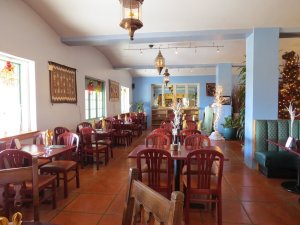
I met a woman I know through Facebook for lunch. She’s one of the few people I’ve “liked” on Facebook without actually knowing her. She took me to a fabulous place called the Back Street Bistro where I had a seafood chowder. GO to this place if you’re ever in Santa Fe!

Then, I caught up with an old Bisbee friend who now lives north of Santa Fe. I hadn’t seen her in five or six years. We had coffee near the plaza. Good, New Mexico coffee, the kind that is brewed with piňon. I may have to buy thirty or forty pounds of it. Well, maybe two.

I found another Route 66 motel – an old and worn motor lodge with carports. I chose it especially for the carports because more snow was predicted, and I didn’t want to have to scrape Lucille with a credit card. Again.

But – no snow.  This morning I’m off to breakfast with another old friend from Bisbee. I haven’t seen this woman in maybe fifteen years!

El Santuario de Guadalupe, downtown Santa Fe.

Phoenix to Gallup

I picked up my friend Seasi from the Phoenix airport on Sunday. We’ve been friends for around twenty-five years.

We spent a too-brief two and a half days staying at a timeshare she’s got. Spacious, views, hot tub. What more could we have needed? In that time, we hit a thrift store, visited the botanical garden, walked a l-o-n-g loop around Papago Park, watched a few videos, and hit the hot tub repeatedly.

Golden barrel cactus

IMG_0226

Sundial with cacti
Sundial with cacti

This morning I left before nine, wrestling my way through busy streets full of bargain shoppers and people returning gifts. Finally, I was on HWY 87 headed toward Payson.

I crossed the Verde River, her banks lined with cottonwoods still covered in golden leaves. Up through a saguaro forest and into the hills and mountains.  Saguaros with snow-capped mountains in the background.

The first “town” I came to was Sunflower – a scattering of houses and one business: a towing and topless place. What, they tow topless? Something to ponder.

On through Payson and into snow. First it was highway with patches of icy snow and slush, but it soon became icy snow and slush with patches of highway. My 65 mph cruise dropped to 30 and even less. Snow along the road was shoulder high at times.

IMG_0253

Then, out onto high desert grasslands with absolutely nothing in sight other than cattle having lunch. I got to Winslow where I lunched in the Turquoise Room at the La Posada Hotel, a famous, gracious Fred Harvey hotel located on the old Route 66. I had the Signature soup and salad, and all I can say is – wow.

The Turquoise Room - isn't turquoise.
The Turquoise Room – isn’t turquoise. I had the signature soup and salad combo and all I can say is wow.

The cornbread served with lunch was drizzled with mesquite bean syrup.


I considered staying in Winslow for the night just so I could return and try the Route 66 Cadillac Margarita.

Lunch
Lunch

IMG_0261

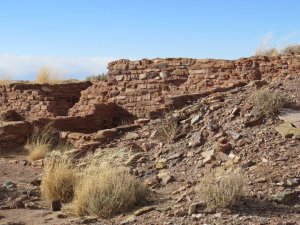
Rather than stay, though, I headed a bit east and visited the Homolovi (huh-MOE-luh vee) Ruins, an ancient Hopi village. The area is only partly excavated, and in one place I stepped on what appeared to be an exposed wall. The Little Colorado River was nearby, but I didn’t go riverside.

IMG_0269

Why I didn't go to the river.
Why I didn’t go to the river.

I wanted to stay, but a) it was chilly (upper 40s), b) there was a fierce wind coming from the southwest, and c) snow clouds were blowing in on those fierce winds. In the fifteen or so minutes I wandered through one site, the clouds came maybe ten or fifteen miles closer. I headed east.

I ended up in a motel on Old Route 66 in Gallup. There were fancier – and more expensive – places to stay, but the place I got is comfy, warm, and has a fridge, coffeepot, and microwave.

I settled in with a bag of Trader Joe’s popcorn and a glass of wine.

IMG_0283

Lucille

I finally have a fancy car (if you count an almost seven year old RAV as fancy – I do). It came with a few bells and whistles: a driver’s seat that glides forward and back, up and down. A sunroof that opens to let in fresh air. A CD player that holds more than one CD. An electronic key with which I can lock or unlock my car from a distance.

But shortly after I got my car (her name is Lucille), the key began to disintegrate. I learned a few weeks ago that the housing could be replaced and my key’s innards could be transferred to the new housing. Its $50 price tag seemed a bargain compared to a whole new key for $210.

So when I got my car serviced the morning of this trip, I picked up the new key housing and had the innards moved into it. My car was done in record time and I zipped off to my first stop: a night in Tucson with an old friend I hadn’t hung with in years. We caught up on things, had a great dinner, I saw her daughter and met her grandsons, and we settled in for the night.

Up in the am. Coffeed up and ready to go. Loaded the car, hopped in, turned it over. The engine made its gr-r-r-r noise but wouldn’t start. I tried again. Again.

I dashed back to the house, explained the situation and asked my friend for her car manual. She also has a RAV, and Lucille didn’t come with a manual. I looked up the strange yellow light that had appeared on the dash when the car refused to start. Engine failure.

Engine failure! No! I had a trip to take, a friend to pick up at the Phoenix airport! I’d just had it serviced! It was Sunday and no Toyota dealerships were open!

My friend’s roommate tried to start the car. She then looked under the hood. Even though she’s an experienced mechanic, she moaned when she saw the complexity of Lucille’s computer-run engine. She tried to start the car again. We grimaced.

I then made calls to car-rental agencies, trying in vain to find one nearby. I had to contact one at the airport to find one open on a Sunday. My cellphone dropped the call when I finally got through to a human being and was beginning the process of renting a car. Tried again, made it, and got ready to head 20 miles south to the airport.

I took my old key off the key ring, handing it to my friend’s roommate and explaining why it had holes where buttons were supposed to be. I planned to call Toyota the next day and hoped they’d come tow the car. I knew I’d have to come back down and deal with it eventually but hoped the process could get started without me.

My friend’s roommate turned the key over in her hand and said. “Did you try this one?”

I hadn’t. I’d used my new key.

She insisted on trying the old one, and though I was sure in the deepest part of my soul that Lucille was in dire straits, that I’d be in a rental for weeks, that my vacation was destroyed, and that my friend’s roommate was out of her mind, we trooped out and she jumped in the car. And started it right up.

Miracle of miracles! A bad key! A well car!

Guess that peacock I’d seen the day before was good luck after all.

Peacocks

I left Saturday morning for a two-week jaunt through Arizona and New Mexico.

I live on a short block, the second of two houses on a dead end street. A main (if you can call it such) street is just 100 feet from my yard. I pulled to the end of my street and turned onto the main street. Came to a halt.

One of the neighborhood peacocks had hopped off the curb and was taking a leisurely stroll across the street. He didn’t look my way, seemingly knowing I’d brake for him and let him go on across.

He didn’t look much like a peacock, though, because he had no tail feathers! I couldn’t imagine why. Actually, I could. I imagined someone stealing them, selling them. Someone who wanted a little holiday cash.

But on occasion, I think about signs and symbols. What could it mean to be cut off by a peacock? What do peacocks symbolize? I hit the internet.

In Hinduism the Peacock is associated with a diety called Lakshmi who represents patience, kindness, benevolence, compassion, and good luck. I like that.

I think of myself as fairly kind and benevolent and compassionate. I could use the good luck, especially setting off on a 1500 mile trip. As far as patience goes, I can use that, too.

In Christianity, the peacock represents resurrection. This is probably because peacocks molt. They actually loses those beautiful tail feathers each year, at the end of summer. And this probably explains why the bird I saw was tail-less. Or perhaps it was one of the females, a peahen. Females don’t carry the gorgeous feathers the males have.

If it was a molting male I saw, end of summer could be pretty relative. In Maine, that’s August, I suppose. But here in Arizona, end of summer can be October. Because this was an Arizona peacock, he may have lost his feathers only a few months ago and would just be starting to grow them back.

Even without the tail feathers, I knew it was one of the neighborhood peacocks. He looked a bit turkey-ish without his tail, but peacocks have a certain arrogance that makes them unmistakable.

His arrogance showed in the way he didn’t bother to glance my way. It showed in the way he not only didn’t quicken his walk but in fact seemed to slow his step, to take his time. It showed in his walk: he acted like he still had that four-foot train of feathers dragging behind him. The way he walked, as though dragging the tail, made me believe he was male.

Peacocks also represent protection, another thing that’s good to have along on this trip. Some see the bird as a symbol of enlightenment. I’ll take that, as well.

Because of the eyes in their tail feathers, peacocks are considered “all seeing” in some cultures. They represent the one who can see truth and justice. There’s a piece of me in this, too. Of course, if it was a female that I saw rather than a molting male, I guess this one doesn’t count.

Peacocks also represent peace. For Buddhists, it’s wisdom and purity.

Because of the way peacocks can spread their tails wide, they are associated with openness. And finally, because they can safely eat poisonous plants they are considered a symbol of immortality and, according to Buddhists, the ability to survive in the face of suffering.

Of course, there are a few negatives. Peacocks are considered vain and foolish. I suppose that’s true considering the way this bird strutted in front of a moving car.

Felted Hat Class

Today I attended a class on how to make a felted hat, taught by Deb Moroney of the Bisbee Fiber Arts Guild. Twelve of us muddled through, had a blast, and went home with a hat.

Deb Moroney shows us a few hat styles.

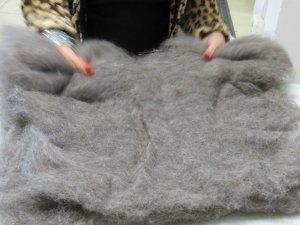
First we each of us chose a piece of wool batting and divided it into four somewhat equal pieced.

Gently tearing the batts into four pieces.

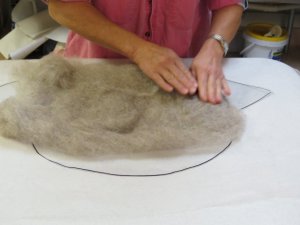
Then we stretched out one piece to cover the pattern we’d chosen. It took awhile for me to get mine to the right shape. I wet the wool with warm sudsy water and then stretched out another piece of batting to top it with. Then I covered the sudsy mess with tulle and patted it into shape. I flipped the whole thing over, repeated the process on the other side, and wrapped edges of the fibers from the first side over the second side so the whole thing would felt together.

Shaping felt to pattern.
Patting and patting the layers of wool.

Then the fun: choosing pieces of wool and yarn to decorate the hat.

All four layers shaped to fit the pattern.
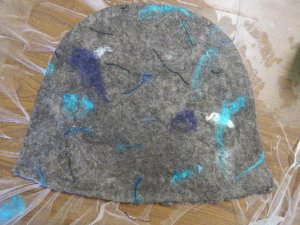
All decorated.
All decorated.

Next, I rolled the whole dripping hat in a large mat made of reed and rolled the hat to begin the felting process. I’d remove the hat, turn it a different direction and roll some more. Repeat, repeat, repeat. This process felted the decorative yarn and wool to the hat. Then I turned the hat inside out and rolled some more. The more I rolled, the more the hat shrank and the better the decorations stuck to the hat.

Rolling, rolling, rolling.

Finally, my hat was small enough to go into a hot water bath. Then the hard work – throwing the wet mess onto the table repeatedly. The combination of hot water and agitation causes the wool fibers to meld together and create felt.

Throwing the hat.
Throwing the hat.

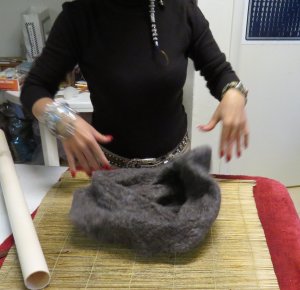
Then I used a form to shape my hat, but the form was enough larger than my head that I had to sort of freeform the hat.

Hat and a
Hat and a hat form.
Shaping hats.
Shaping hats.
Shaping the hat.
Shaping the hat.

Eventually, I was done. A day of fun and a wonderful new hat!

IMG_0171
If you are in Bisbee, be sure to visit the Guild’s Fiber Shop which is open Fridays and Saturdays, located in the basement of the old YWCA.

IMG_0148

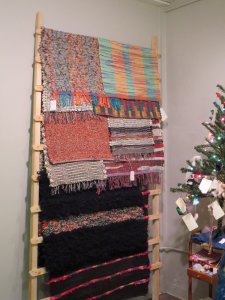
Lots of woven rugs.
Lots of woven rugs.
Hats and scarves.
Hats and scarves.
Prize winning designer items.

Día de los Muertos

It’s Día de los Muertos. November 2nd is Day of the Dead in Mexico and all points south.

Yesterday, Pam, Debbie and I went to the cemetery in Bahía de Kino because we’d heard children were honored on the 1st. Few were there other than three children taking turns sweeping off a tomb. But as we wandered through we noticed that children’s tombs were already decorated with streamers and balloons, either pink or blue.

Balloons, slightly deflated, the morning after. On November 2nd, I saw the young mother sitting there at the grave of her dead daughter.

Debbie and I went back today, a little after noon. The road in front of the cemetery entrance was closed off with plastic yellow tape, sort of like tape used to enclose a crime scene. We found a shady pace to park, ducked under the yellow, and approached the cemetery.

Directly across from the entrance venders’ booths had sprung up. Food, water, candies. And of course, the most important, flowers.

Two main kinds of flowers are used on Day of the Dead, and in general, for remembrance throughout the year: marigolds and gladiolas.

The flower vender had a booth maybe twenty-five feet long, spilling with color: the golden-yellow and orange of marigolds – margaritas – and the rainbow colors of gladiolas – gladiolos. They’d been set up yesterday, too, but there were far fewer today.

We entered the cemetery and it was filled more with life than with death. Children played on tombs while the elders sat on them. Entire families sat in white plastic chairs placed in a U shape along the sides and base of the tombs.

Shade structures had sprung up, some large enough to accommodate thirty or more people. Poorer folks gathered simply, sitting on the ground, on a blanket, or perched on concrete blocks. Some of the dead were honored with music spilling from boom boxes.

I’d expected to smell the flowers as hundreds and hundreds of them were in this block-square cemetery. Or if not flowers, food. However, the overall smell was of fresh cement.
Families were constructing tombs or adding on to ones that had been started in previous years. One man was tiling the arch that sat at the head of the tomb. A few concrete slabs were being painted. Families who had just arrived were busy sweeping, and women with buckets were at every spigot to gather water to wash down the tombs.

Flowers decorated many of the gravesites, of course. Some already held candles, though they wouldn’t be lit until nightfall. Others had little bowls of jam. A few had cookies. And of course, it wouldn’t really begin until tonight.

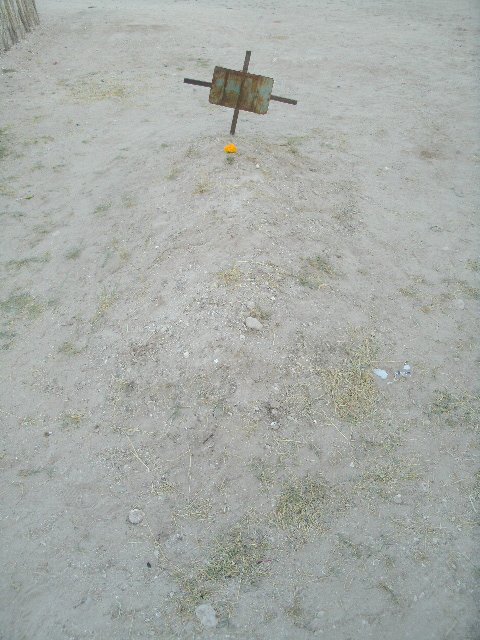
A simple grave.

We returned at dusk, walking toward the cemetery just behind a woman and her daughter. They had their heads together, whispering. Finally the little girl turned around and asked us who we were going to visit. I kept trying to explain that we were going, in general. Then she began asking if we knew Phoenix. Suddenly I realized she wasn’t saying Phoenix, but Felix. I said no, we didn’t know him.

The woman looked somewhat irritated with us. She explained that Felix was her husband and that he’d been dead only four months. Eventually, we all began to walk on. I asked if we could meet Felix, and clearly that is what the entire conversation had been leading to. She was delighted to introduce us to her husband.

We followed the woman and girl to the graveside. It had been topped with a cement slab, as many are. The slab was covered in blue tile, and it was lovely. Flowers and a wreath sat at the head, along with Felix’s birth and death information.

Felix’s grave, lovingly decorated.

We stood awhile, asking about her husband, and it actually turned out we did know the man slightly. He’d been a fish and vegetable peddler who often came through Islandia to sell. She said he was a good man, a good husband and father. Here’s where my translation went awry, though. He either got drunk, fell into the sea and drown, or a drunk pushed him into the sea and he drown. Either way, four months ago he drown, and this was their first Día de los Muertos.

After a time, we slowly circled our way around the cemetery, greeting people when appropriate. Everyone was smiling. No tears, no sadness. Abundant joy.

As we left, we wandered back to Felix’s grave, but his wife and child weren’t around. We said our goodbyes to the fish and vegetable peddler and quietly left.

The morning after – a forgotten broom.

Bobitos y Mas

The bobitos are relentless.

I don’t know if bobito is a Spanish word, a word used in Mexico, or simply a Kino slang phrase. But what it translates to is this: tiny evil fly that irritates beyond belief.

Bobitos, so I am told, originate on Isla Alcatraz, the island less than a mile offshore from where I live when here. The island is protected because gulls and boobies lay their eggs there, and seals frolic on the far side of the island. So, according to the story, an insecticide can’t be used there because of the birds and seals. Good move, I think.

But I am beginning to rethink.

Bobitos arrive in spring, late March or so. They usually hang around a month or two and then disappear. However, this is November 2nd, and they are thriving along the coast.

I just did a mile walk up the beach toward Kino Nuevo and was assaulted by these tiny bugs. They don’t bite. They simply assault and annoy. They go for eyes, insides of ears and nose, and armpits. But barring that, they will land anywhere on a human body. At one point, my right upper arm had over a dozen of them, and this was about four seconds after I’d swiped at the last batch.

Annoying as hell.

But, there was a wonderful plus to the beachwalk.

You all know I kind of like dead stuff. Not animals that have been hit by a car, but things that appear to have died a natural death. I make an exception for fish, though. When there’s a dead fish on the beach, it is often what’s left after someone’s dinner.

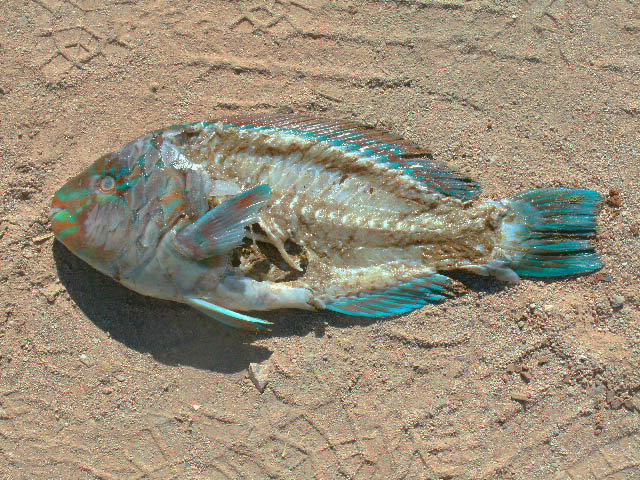
And today I made a wonderful find. A fish, maybe 14” long and 8” tall. It had been beautifully and perfectly filleted, so what was left was the top of its back, the bottom of its belly, its head, front fins, and tail.

Those parts that were left were beautiful. A turquoise blue. I’d never seen one like it. And the bobitos weren’t bothering it one whit.

I don’t know if its beautiful colors came to it in death or if it were lucky to have lived a life of beauty. Either way, though, I hope it was as delicious for someone as it was beautiful. Here it is.


Freewrite Fiction

I go to a Freewrite group twice a month if I’m in town. Attendees bring in writing prompts on a rotating basis, but we can also write without the prompts. The goal is to simply write.
Last week, a woman brought lines from songs. I pulled out several but settled on a line from a Crosby, Stills and Nash song – Suite Judy Blue Eyes. The line was this: Fear is the lock, and laughter the key to your heart.
I pulled it out, thinking of writing about the need to laugh more, or how to quell fears. But the moment I put pen to paper, something completely different came out. What follows is what I wrote – a complete fictional account. Let me know what you think. And remember, I don’t write fiction.

He made her laugh, but not enough for the key to work. There was just enough fear to keep her heart locked.
She wasn’t quite sure what it was that caused the fear. The bit of swagger in his walk? Perhaps, but she hadn’t minded the swagger Bobby’d had each time he led her to the dance floor, or to the pier, or to his bed.
Was it that darkness in his eyes? Not the brownness, but the darkness that overlay everything else.
That must be it. The darkness. She’d seen that same darkness in the eyes of a man on trial for murder when she’d sat on the jury. And she’d convicted him, too. Partly because of his eyes.
Now, here were those eyes again, the eyes of a murderer. His laughter and his ability to make her laugh nudged the key, pushing into her heart, but then he’d look at her a certain way, and the lock was firm once again.
It was the way he kept his head, facing down, and turned slowly to the side and up to look at her. Each time it made her flinch.
But now what was she to do? She’d been crazy to let him know where she lived. How was it he’d got it out of her?
And now, there he was across the table from her. Turning his head to the side and up to look at her.
She got up from the table and excused herself, saying she was sorry but she wasn’t feeling well and had to go home.
When she got there, she double checked the doors to be sure they were locked and made sure all the windows were tightly closed.
He used a glass cutter to come in through the window in the den.