Today I attended a class on how to make a felted hat, taught by Deb Moroney of the Bisbee Fiber Arts Guild. Twelve of us muddled through, had a blast, and went home with a hat.
Deb Moroney shows us a few hat styles.
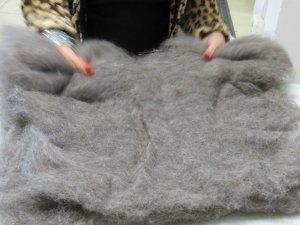
First we each of us chose a piece of wool batting and divided it into four somewhat equal pieced.
Gently tearing the batts into four pieces.
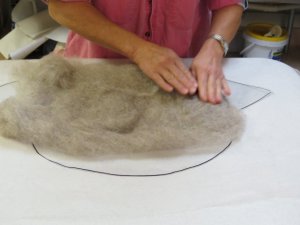
Then we stretched out one piece to cover the pattern we’d chosen. It took awhile for me to get mine to the right shape. I wet the wool with warm sudsy water and then stretched out another piece of batting to top it with. Then I covered the sudsy mess with tulle and patted it into shape. I flipped the whole thing over, repeated the process on the other side, and wrapped edges of the fibers from the first side over the second side so the whole thing would felt together.
Shaping felt to pattern.Patting and patting the layers of wool.
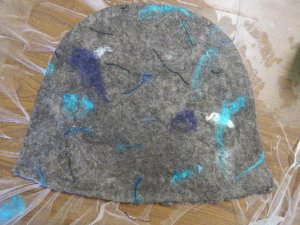
Then the fun: choosing pieces of wool and yarn to decorate the hat.
All four layers shaped to fit the pattern.All decorated.
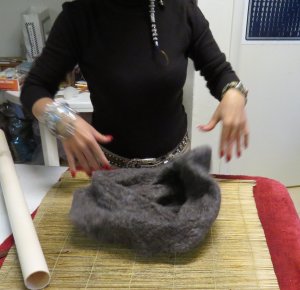
Next, I rolled the whole dripping hat in a large mat made of reed and rolled the hat to begin the felting process. I’d remove the hat, turn it a different direction and roll some more. Repeat, repeat, repeat. This process felted the decorative yarn and wool to the hat. Then I turned the hat inside out and rolled some more. The more I rolled, the more the hat shrank and the better the decorations stuck to the hat.
Rolling, rolling, rolling.
Finally, my hat was small enough to go into a hot water bath. Then the hard work – throwing the wet mess onto the table repeatedly. The combination of hot water and agitation causes the wool fibers to meld together and create felt.
Throwing the hat.
Then I used a form to shape my hat, but the form was enough larger than my head that I had to sort of freeform the hat.
Hat and a hat form.Shaping hats.Shaping the hat.
Eventually, I was done. A day of fun and a wonderful new hat!
If you are in Bisbee, be sure to visit the Guild’s Fiber Shop which is open Fridays and Saturdays, located in the basement of the old YWCA.
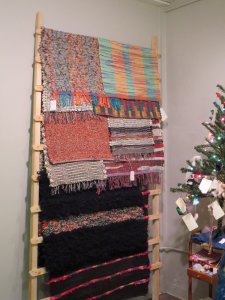
Lots of woven rugs.Hats and scarves.Prize winning designer items.
I go to a Freewrite group twice a month if I’m in town. Attendees bring in writing prompts on a rotating basis, but we can also write without the prompts. The goal is to simply write.
Last week, a woman brought lines from songs. I pulled out several but settled on a line from a Crosby, Stills and Nash song – Suite Judy Blue Eyes. The line was this: Fear is the lock, and laughter the key to your heart.
I pulled it out, thinking of writing about the need to laugh more, or how to quell fears. But the moment I put pen to paper, something completely different came out. What follows is what I wrote – a complete fictional account. Let me know what you think. And remember, I don’t write fiction.
He made her laugh, but not enough for the key to work. There was just enough fear to keep her heart locked.
She wasn’t quite sure what it was that caused the fear. The bit of swagger in his walk? Perhaps, but she hadn’t minded the swagger Bobby’d had each time he led her to the dance floor, or to the pier, or to his bed.
Was it that darkness in his eyes? Not the brownness, but the darkness that overlay everything else.
That must be it. The darkness. She’d seen that same darkness in the eyes of a man on trial for murder when she’d sat on the jury. And she’d convicted him, too. Partly because of his eyes.
Now, here were those eyes again, the eyes of a murderer. His laughter and his ability to make her laugh nudged the key, pushing into her heart, but then he’d look at her a certain way, and the lock was firm once again.
It was the way he kept his head, facing down, and turned slowly to the side and up to look at her. Each time it made her flinch.
But now what was she to do? She’d been crazy to let him know where she lived. How was it he’d got it out of her?
And now, there he was across the table from her. Turning his head to the side and up to look at her.
She got up from the table and excused herself, saying she was sorry but she wasn’t feeling well and had to go home.
When she got there, she double checked the doors to be sure they were locked and made sure all the windows were tightly closed.
He used a glass cutter to come in through the window in the den.
There has been too much death in my life recently.
In the past month, I have lost three friends and my Godmother,who was in her late 90’s, and in my sister’s family, her husband lost a sister and his mother.
I don’t even begin to understand how to grieve when so much comes so fast. I just keep feeling like I’m being knocked down. I start to get up again, and wham! It happens again.
My brother-in-law’s mother lived to be over 100. I had met her, but didn’t really know her. With such a long life – and it was a good one – I cannot feel too badly. His sister, well, that is something else. Again, I didn’t know her well, but the shock of an unexpected death of a healthy woman had a profound impact on my sister’s entire family. Then the mother died just a few weeks later.
Closer to home, my Godmother was my mother’s best childhood friend. Aunt Mart abandoned rural Pennsylvania for Chicago, and my mother followed soon after. Mart had been raised on a farm, and my mom was a townie. Somehow, they became quite close.
My mother (Emilie), Aunt Mart, and my maternal grandmother (also Emilie).
As recently as last year, the last time I saw Mart, she talked with animated detail about the day I was born and how she’d felt seeing me for the first time. She glowed like she’d been the one to give birth.
Mart moved to Las Vegas from Chicago when her son moved there, and lived in her own home. Her son took her shopping weekly.
Mart with her son, Chip, summer of 2009.
I visited her yearly. Not nearly enough, but what I could manage and afford. Each time I’d go, we’d have a celebratory dinner at Mimi’s Restaurant, a place she loved. Last time, I also introduced her to Joe’s Crab Shack, and she made me swear I’d take her back on my next visit. The next visit was scheduled for this winter. Mart – I send love and thoughts of crab your way.
My sister, Jean (best sister in the world), Aunt Mart, and me – after dining at Mimi’s in 2010.
Mart and me after dinner – at Mimi’s – in 2011.
The other three who died were all male. One I didn’t know well at all, but I know and like his wife. The other is a man I met the day I first visited Bisbee. I somehow ended up at a party he was throwing, and that’s what got me stuck in Bisbee overnight. It changed my life.
I’ve known this man for nearly forty years. I had recently reconnected with him and it was such a pleasure to get to know him again.
The other who died, also male, was someone I knew thirty-five years ago. We had a lot of fun times together long ago, and for the last year or so had been connected through Facebook. This modern technological marvel allowed us to stay in touch, see each other’s photos, and reconnect over a large distance.
There is really nothing more to say other than I am sick of all the death.
My friend Christina (author of Drive Me Wild: A Western Odyssey) says that every day past fifty is a gift. In years past, everyone my age would already be dead. Before penicillin, a bout of pneumonia or any kind of infection due to an injury could have been deadly. Cancer, for sure, killed people – if they lived long enough to get it. I know all of this is true, and most days I feel exceedingly grateful for another day in decent health.
But still, it is hard to lose a friend and to lose my Godmother. And to have so many deaths happen in such a short period of time sends me reeling.
A Tucson friend is always shocked that each time I see her I have lost a friend. I won’t even tell her of the number since I saw her about six weeks ago.
It was hot in Tucson. Not scorching like it had been for the last four months, but hot. Low 90s.
I had slipped into Beyond Bread to cool off with an iced tea and use its wi-fi to check my email. I had a message from my friend Christina: she had a new posting on her blog (check it out at christinanealson.blogspot.com). She described a labyrinth where she’d recently taken a walk.
Inspired, I logged onto labyrinthlocator.com to see what I might be close to. Bingo. There was one about four miles away, in the yard of a church.
It was a lovely church grounds, and I wandered a bit, finally noticing a patch of desert to the east with a sign that said Desert Sanctuary. Made perfect sense.
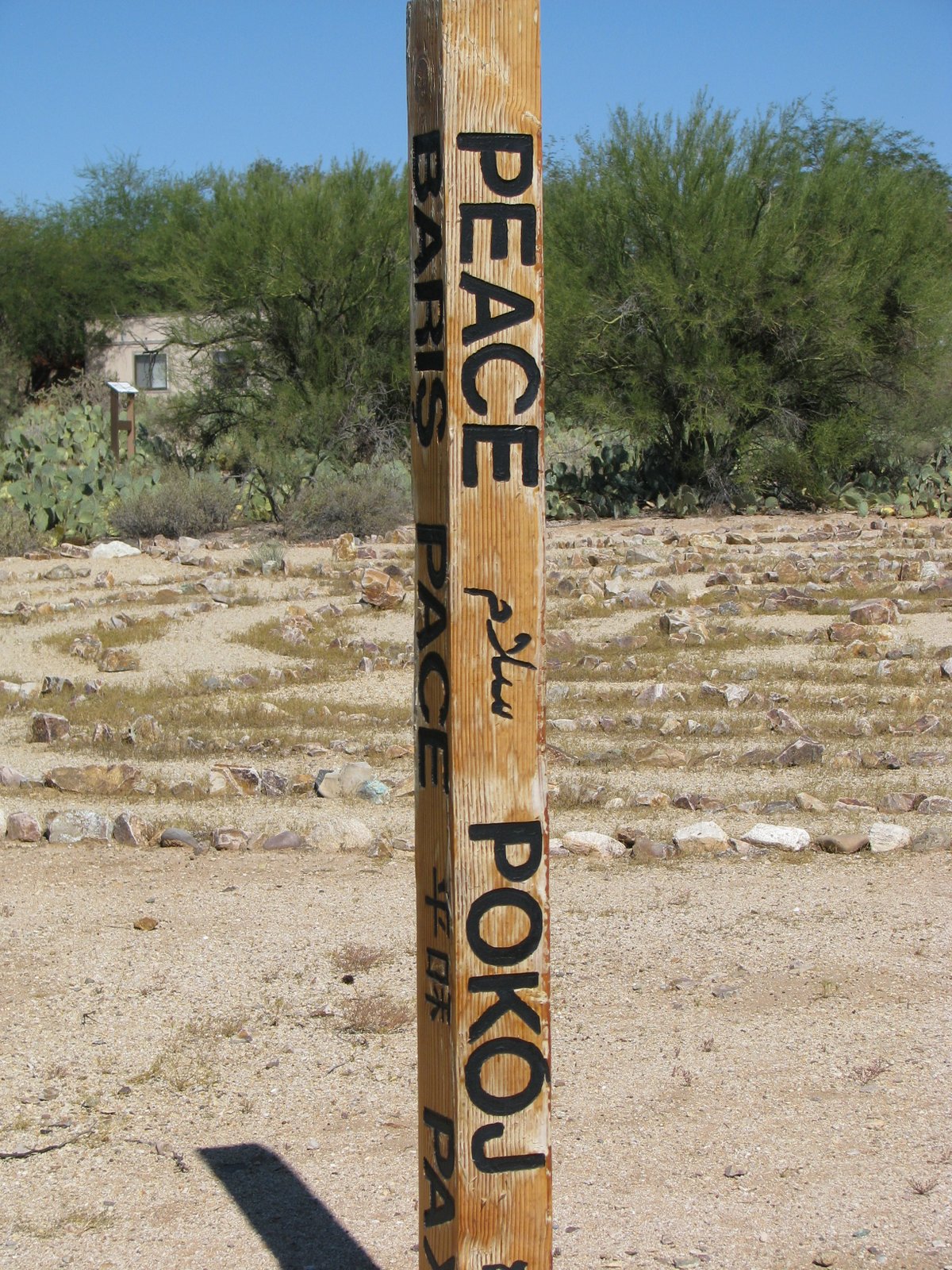
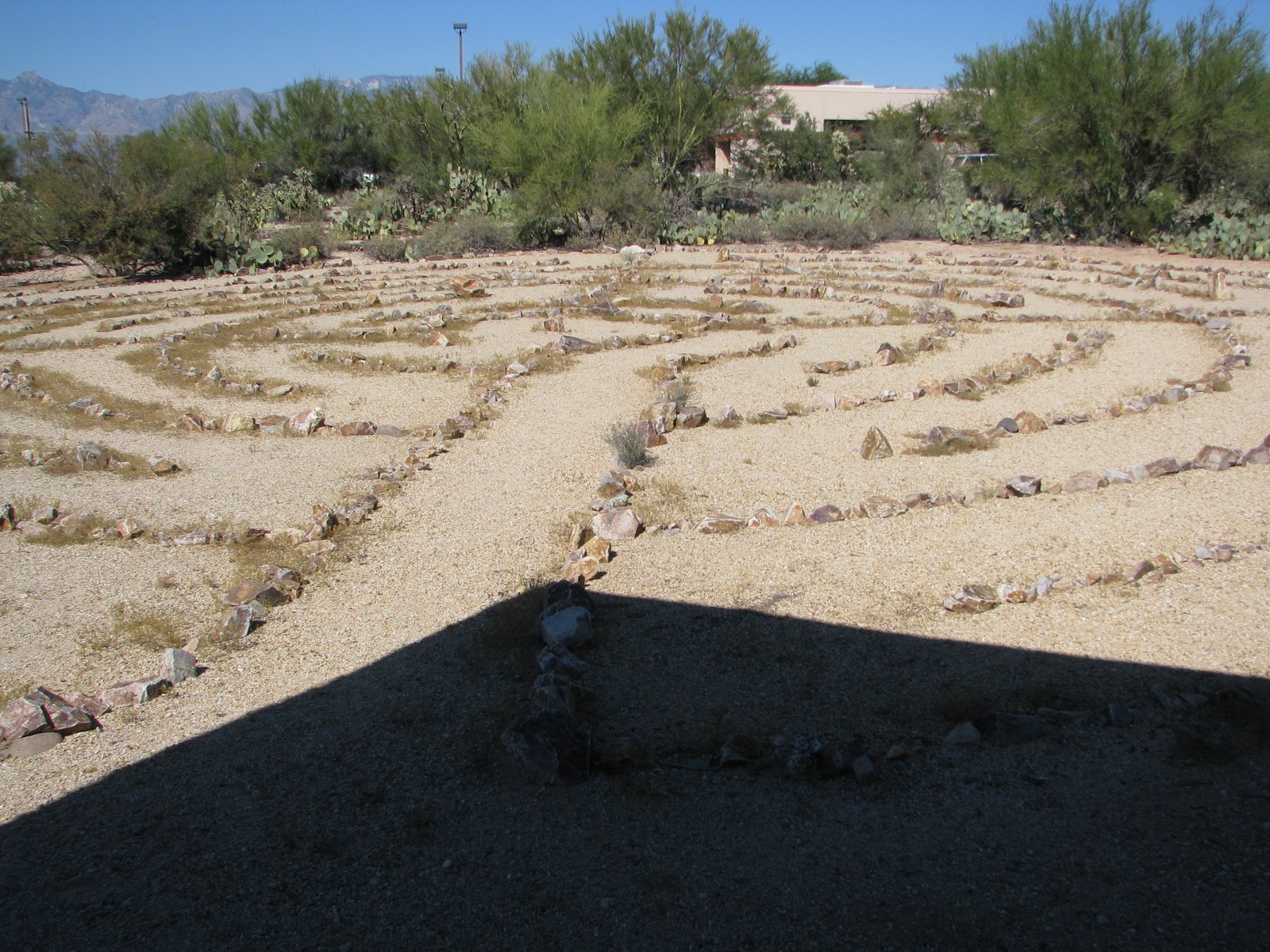
I walked down the path, and there it was. It was fairly large – maybe forty feet across, laid out simply with desert rock. Near the entrance was a ramada with shaded benches, and just to the side was a peace pole, a 6×6 post, set into the ground, and standing over six feet tall. On each side the word ‘peace’ was written in a variety of languages, maybe fourteen or fifteen in all. Simple, like the labyrinth.
Christina had walked her labyrinth barefooted and suggested it. Well, she is in Montana and was walking on wood chips. I am in Arizona in an area of many thorned shrubs like cholla, prickly pear, and even the mesquite and whitethorn. And the path was of pebbles. I kept my shoes on.
The labyrinth appeared to be perfectly aligned to the four directions with the entrance on the south. The north-south line extended from the center circle nearly to the outside edge, with just one pathway open at each pole. The east-west line did the same, with openings on the far east and west.
Entrance to the labyrinth from the shade of the ramada.
I walked it slowly, pausing at each cardinal point to say a little prayer of gratitude. When I reached the center, I first faced each direction and said another brief thanks and then also thanked Father Sky and Mother Earth, stretching first up tall and then squatting down to put my hands on the ground.
Center, facing south.
I stood there a few minutes, taking in the near silence. I was amazed it was so quiet as it stood a mere half block from a fairly busy road. But quiet it was, and I relished it.
Then I slowly made my way back out and took a seat under the ramada. The twenty or so minute walk under desert sun had left me quite hot and thirsty. But as I walked back out to the parking lot, I saw a path off to the south that I’d noticed on the way in.
Over a little bridge and onto a pathway that noodled around and completely circled the labyrinth. And each sixty paces or so, there was a bench and a station of the cross.
What? For some reason, I though walking the stations of the cross was a Catholic thing. Here I was at a Presbyterian church and there was a simple walk through the stations. With the labyrinth, it was quite an ecumenical event.
Eventually, the path circled back to its entrance, and I crossed the hot tarmac to my car, which I’d parked under a big, shady mesquite.
Raindrops on roses, and whiskers on kittens.
Yep, these things are pretty good. But more and more these days, my favorite things are in Bahia Kino.
First, of course, there is the sea. Always there. Where else could it go?
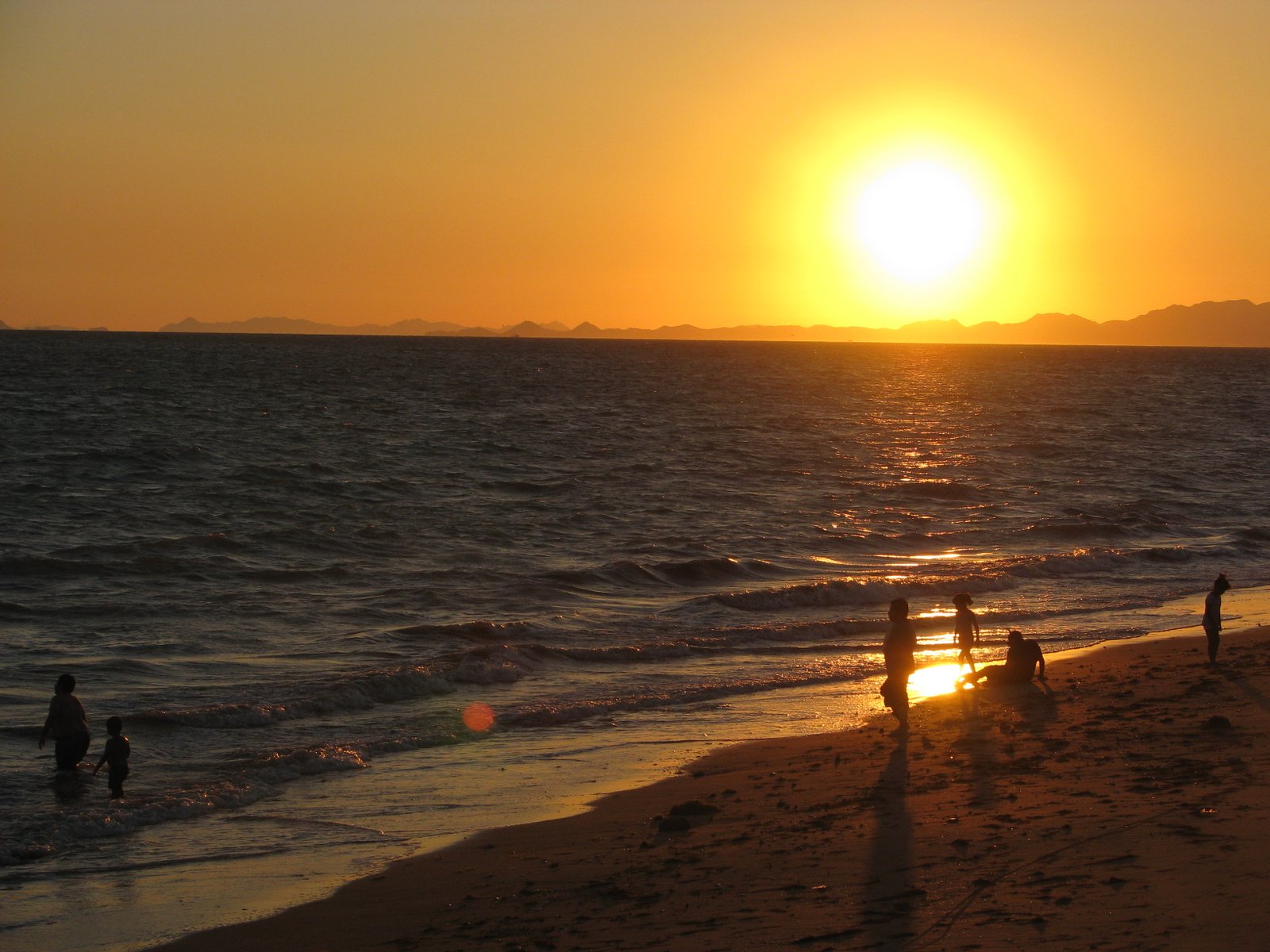
Sunset casts its glow on the water, too.
Shifting between blue and gray, from serene to angry. High tide slamming against the seawall or sometimes barely tickling it. But it is the sea that draws me here over and over again.
Then, food! I have a friend who has lived here for many years, and she has tired of the sameness of the food. There is not much real Mexican food other than seafoods prepared in Mexican styles.
Now, a part of me simply cannot imagine tiring of fresh seafood. Fresh as in right-off-the-boat seafood. A favorite memory is strolling the beach one morning, greeting a fisherman and asking about his catch. My friend and I were able to choose a fish and have it boned and filleted in front of us in a matter of minutes.
On the other hand, there are lots of foods I love that simply don’t exist here. Simple things like hearty wheat bread or cheddar cheese. Would I tire of the food if I were here full time? Yes, I imagine I would.
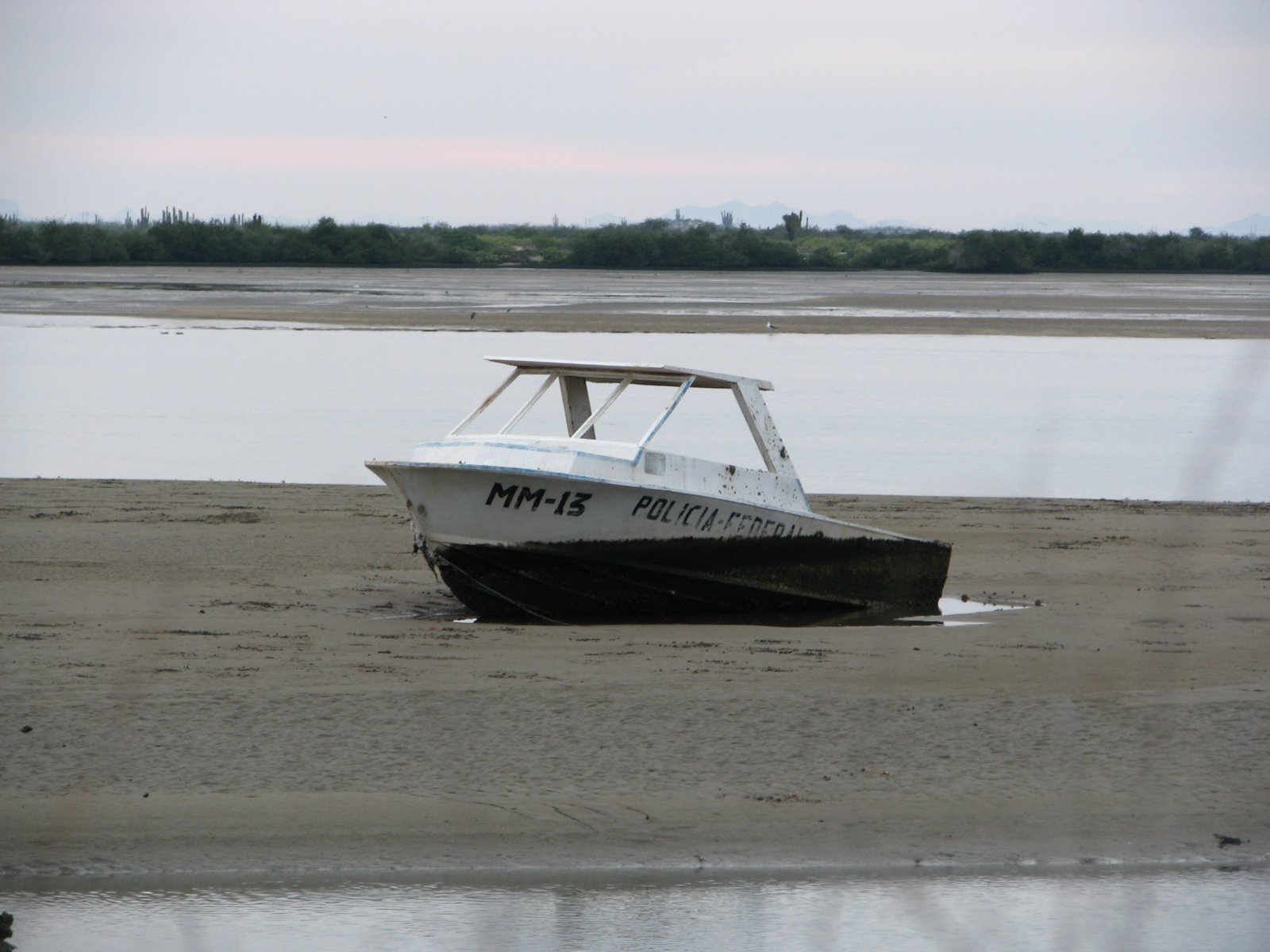
There’s also the estuary. It’s a ten- minute drive from my casita (that’s a fancy word for “old trailer in need of work.”) The estuary is filled with egrets, cormorants, and osprey in addition to pelicans, gulls and such. There is also, interestingly, a grounded police boat, though I’ve never been able to learn its story.
Yep, a police boat.
In early morning, right at the entrance to the estuary, fishermen shove their boats off, heading out to sea for a day’s work. There is a shrine to La Virgen, and recently a small open-air chapel has been added.
The new little outdoor chapel. Sweet.
Just a mile away from the estuary’s entrance is an oyster farm and an open-air restaurant sits on the shore. I don’t know its real name, but the first time I saw it I dubbed it the Restaurant at the End of the Universe, as that’s just about how it feels there.
We sit at long picnic-style tables and benches, gaze out on the estuary, and get fresh shucked oysters in a matter of moments. It’s incredibly cheap to eat there. On a good day there’s enough fresh crab to have a crab-draped tostada and still be able to buy a kilo of crabmeat to take home.
Then there are the people. Kino has its share of odd folks like any place, but it also has some of the kindest, warmest folks I’ve ever known.
Last May I was here and got incredibly sick. I actually didn’t mind too much – it forced me to stay here a few extra days. One woman friend brought me more water and Imodium. Another gave me fresh squeezed orange juice, and another provided the proverbial chicken soup. In a small trailer park like the one I’m in, there are always folks who can lend a hand, and I treasure that.
Some of the folks here are incredible, from the woman in the office who can handle anything, to the two young men who maintain the grounds and jump in to help should I need something done.
There are several men who have worked on the trailer and space, one of whom is even known as a legendary organizer in the 70s. I love when he works here since he’s always singing softly as he swings his hammer or lays block.
Then there is my friend the restaurateur. This man owns one of the many open-air restaurants. I stop for coffee there each morning when I go on a walk with women friends. The day I met him – no, the moment I laid eyes on him – I simply adored him. He’s friendly, sweet, and a danged good cook. Now I shop up in “el Norte” for him. A sweater in winter. A pot big enough to hold three kilos of pinto beans. A large container of black pepper.
It’s funny. When I met this man, he was, immediately, a sort of father figure. Come to find out, I’m about a year older than he is. But knowing that somehow hasn’t changed that wonderful fatherly feeling I have for him.
There’s the woodcarver who drops by to try to sell his wares, but is just as glad for a glass of water and some conversation. As he leaves, it’s always, “Thanks, Mama.”
Oddly, I even enjoy finding dead fish and birds on the beach.
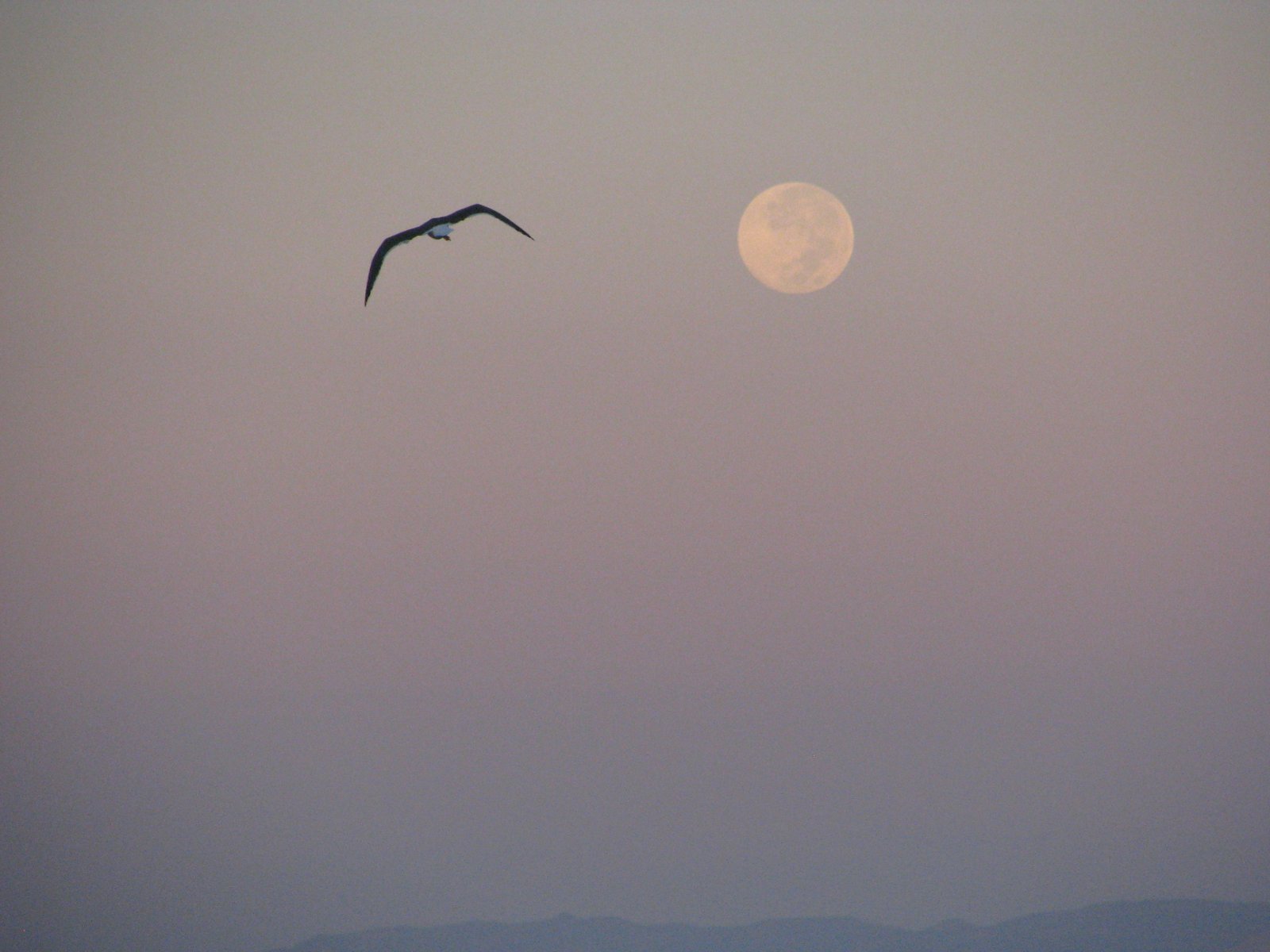
Last, or just about last anyway, is the moon. I never tire of seeing it rise over the sea and cast its silvery light across the water. The last two mornings, the moon has been just about full. My friend and I rose each day in time to sit outside with coffee, watching the moon turn to a shimmering gold, spilling its color across the sea. This morning was probably the most beautiful moonset I have ever witnessed.
Sunrises. Sunsets. Gazing at Isla Alcatraz. Now I sit inside, in the air-conditioned comfort of the trailer, snugged into the cushioned banco. I lift my eyes, just a bit to the left, and there’s the sea.
I can never tire of this.
I used to think a swim would be great on a hot day. And I suppose it is. But today was hot and pretty muggy, and the idea of sitting outside for any length of time – even in the shade- was intimidating.
Mornings are delightful in September. People, locals as well a visitors, are out walking even before the sun is up. I sit watching the pre-dawn glimmer of light on the beach and can see dark shadows moving both directions. Walkers, getting in their daily constitutional before the heat of day. All along the beach, motors fire up and soon fishermen are headed out to deep water hoping for a good day’s catch.
Evenings, too, are wonderful. Some walk the beach while others just sit in the sand. The sea comes alive with swimmers and splashers. Children build castles, dig holes, and basically run rampant across the sand and into the waves.
Dogs loll nearby, praying for handouts or a dropped burrito. Adults pause in their swimming or chatter and turn to watch the sun sink behind the far western islands.
And after it is dark, the beach is still full. Swimmers still splash, lovers stroll. Music erupts from nearby cars or from boom boxes. The playa is alive at night as it never is on a hot summer day.
Although it was hot, we headed out around noon to Kino Nuevo for gas and perhaps some beach time. Then we got sidetracked in an area just outside of town where there are wonderful tidal pools, but the tide was in and there were no pools.
Still, we spent a short but lovely time dangling our feet in the water and watching a group of four young men launch their boat. One was so very, very pale skinned that when he pulled off his shirt, I shuddered at the burn he was sure to end up with.
The public beach has wonderful thatch-roofed palapas, but on weekends the beach is packed, even on hots days, by people from Hermosillo escaping even hotter weather.
We opted to skip the crowds and headed for Jorge’s, a place on the far end of Nuevo known for its views, especially of winter sunsets, and its broad patio facing the sea. When we got to Jorge’s, we were informed that the patio was not functioning.
Off to Casa Blanca, just a short way down the road. This restaurant/bar has a wonderful second story deck overlooking the water. When we got to Casa Blanca we were informed that the second floor was closed.
Off to La Palapa, near the public beach. We smiled as we thought about sitting in the shade sipping a chilada. When we got to La Palapa, the outside area once full of little palapas was gone, a new cement block building going up in its place.
OK. We took the hint. Get out of Nuevo and don’t even think about a chilada in the middle of the afternoon.
Back to Viejo, to La Hacienda, where we hoped to find Edgar and have an iced coffee, but with our current string of luck we figured Edgar would be off and they’d be out of ice. Or coffee. Or maybe the blender would be broken. But miracle of miracles, Hector was there, and there were coffee, ice, and a working blender. We were soon installed at a small table next to the 12′ by 12′ shallow pool.
Having been careful to avoid the beach crowds, it was ironic that this tiny pool was crammed with children and beach toys. About eight children zipped in and out of the water. Also in and out went a floating lounger, two little boats, several fancy inner tube-style water toys, and one inflatable shark. There wasn’t one square foot without a child or toy.
Screams, laughter, splashes – we got it all along with our iced coffees. And it was great. We enjoyed seeing the children having so much fun and were impressed by attentive fathers playing with their children.
We enjoyed the coffee, and got to see Edgar for a few minutes. We even stayed cool, thanks in large part to splashes of children jumping into the pool Then, back to La Casita to hang inside with the A/C on to wait for evening when it was cool enough to again be on the beach.
The priest in Naco, Sonora, was on a mission: get all those folks living together (in sin) and convince them to marry. He was wildly successful, and fifteen couples decided to wed. All together.
Well, one couple backed out, broke up, or something, so on September 22nd, there were fourteen couples who would marry in a joint ceremony at 4:00. One woman planning to marry was my friend Lupita, and she did it up right, white dress, reception, dancing.
Lupita and Bertín have been together for about twenty-one years and have two children and a grandson. When she invited me to the wedding, I teased her, asking if she thought she knew him well enough to marry him.
I arrived at Lupita’s mother’s house early to photograph her as she prepped and dressed. Then she was driven off to the church in a white car.
Lupita’s sister is doing her makeup.Almost ready!
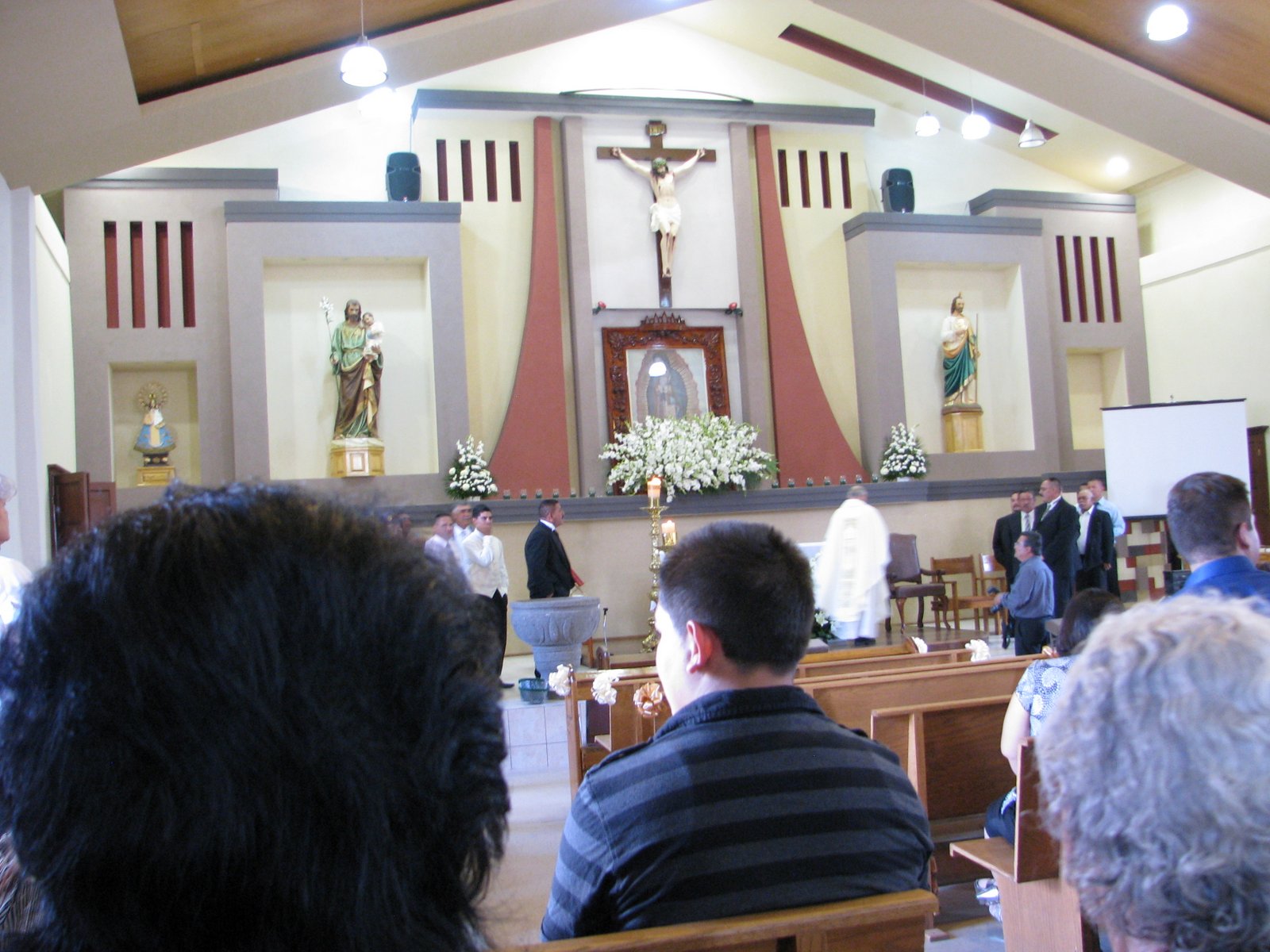
The church in Naco has been remodeled, and is lovely. The stained glass windows were open wide, as were the main and side doors. A large painting of the Virgin of Guadalupe hung on the wall behind the sanctuary, and a long mantle hung across the sanctuary. Flowers surrounded La Virgin and were draped on the mantle, and there were fourteen little vases along the mantle. Fourteen somewhat nervous looking men stood around looking self conscious in front of a church so packed that people spilled out the doorways.
The church – before it filled up.
Two Mexican nuns, in habits complete with veils, were in attendance, as well as my US friend Sister Mary Rose who was in what she claims is her only dress.
The priest, Padre Memo, walked down the aisle at 4 on the dot. Then, the processional. It played, and played. And it played some more. After all, there were fourteen women and their escorts headed down the aisle!
Lupita shone, accompanied by her mother on her left and her brother on her right.
There was a full mass, including singing. There are no hymnals in the church, so a PowerPoint presentation splashed the words across the screen as PowerPoint music played either piano or guitar as the song required.
Padre Memo had two acolytes assisting him. Near the end of the service, the boy holding the book for him apparently had the book upside down. Memo had to reach down and quickly spin it around so he could read.
The couples ranged in age from mid-twenties to maybe early sixties. They were married by repeating a simple vow. A microphone was passed from couple to couple, with the man saying his vows first. Then Padre Memo pronounced them all married and everyone clapped.
Next came communion, first for the couples, then for everyone else who wanted it.
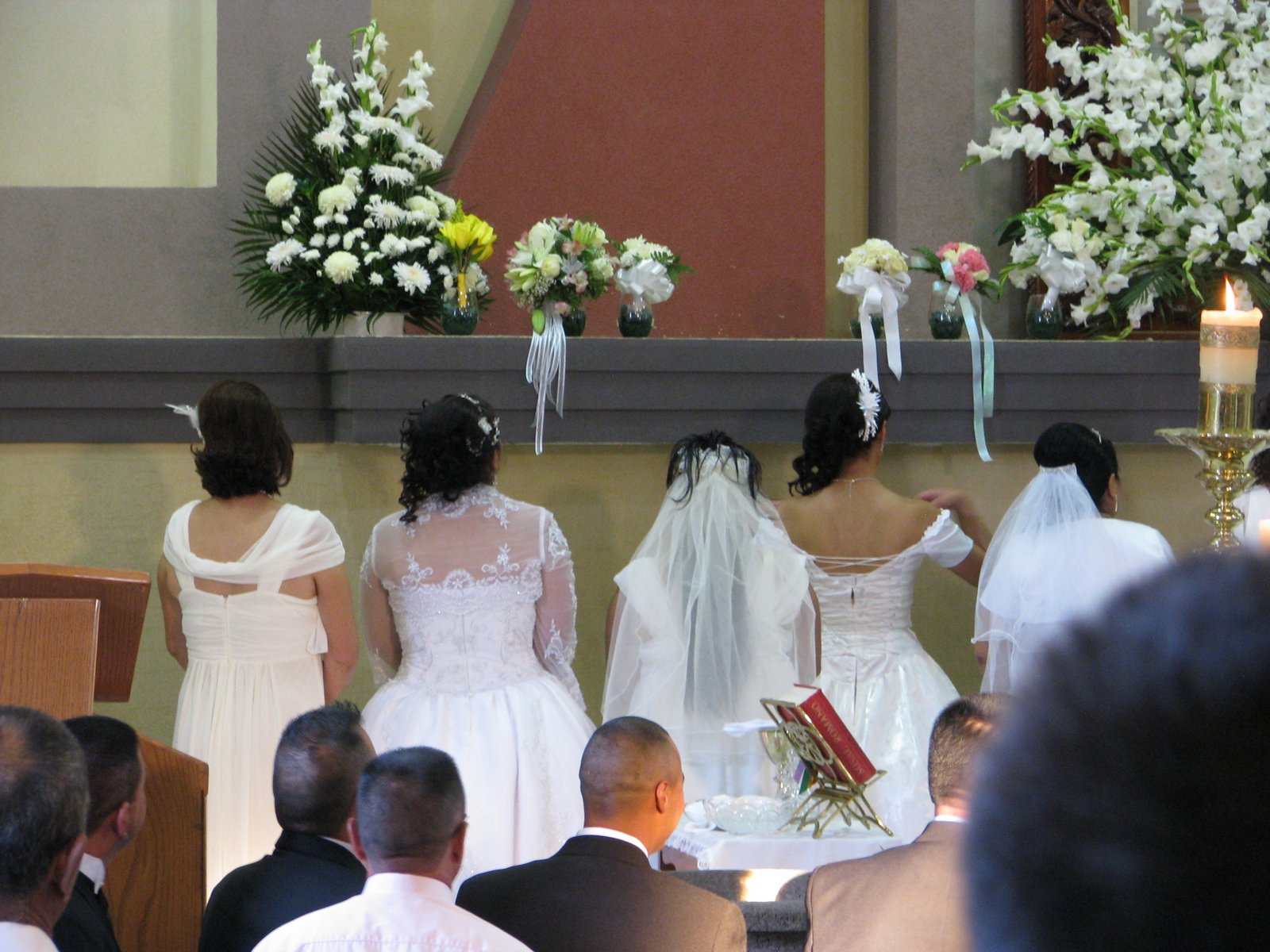
Now the part I liked the best: the newly married women came forward, placed their corsages in the little vases on the mantle, and gazed up at La Virgin while “Ave Maria” played.
“Ave Maria” plays while the women look up at La Virgin de Guadalupe.
Then more singing, and around 5:30, the service was over. The recessional played (and played) as the couples headed down the aisle. That’s when I saw a second woman I knew, walking with her new husband. I’d had no idea she, too, was marrying that day.
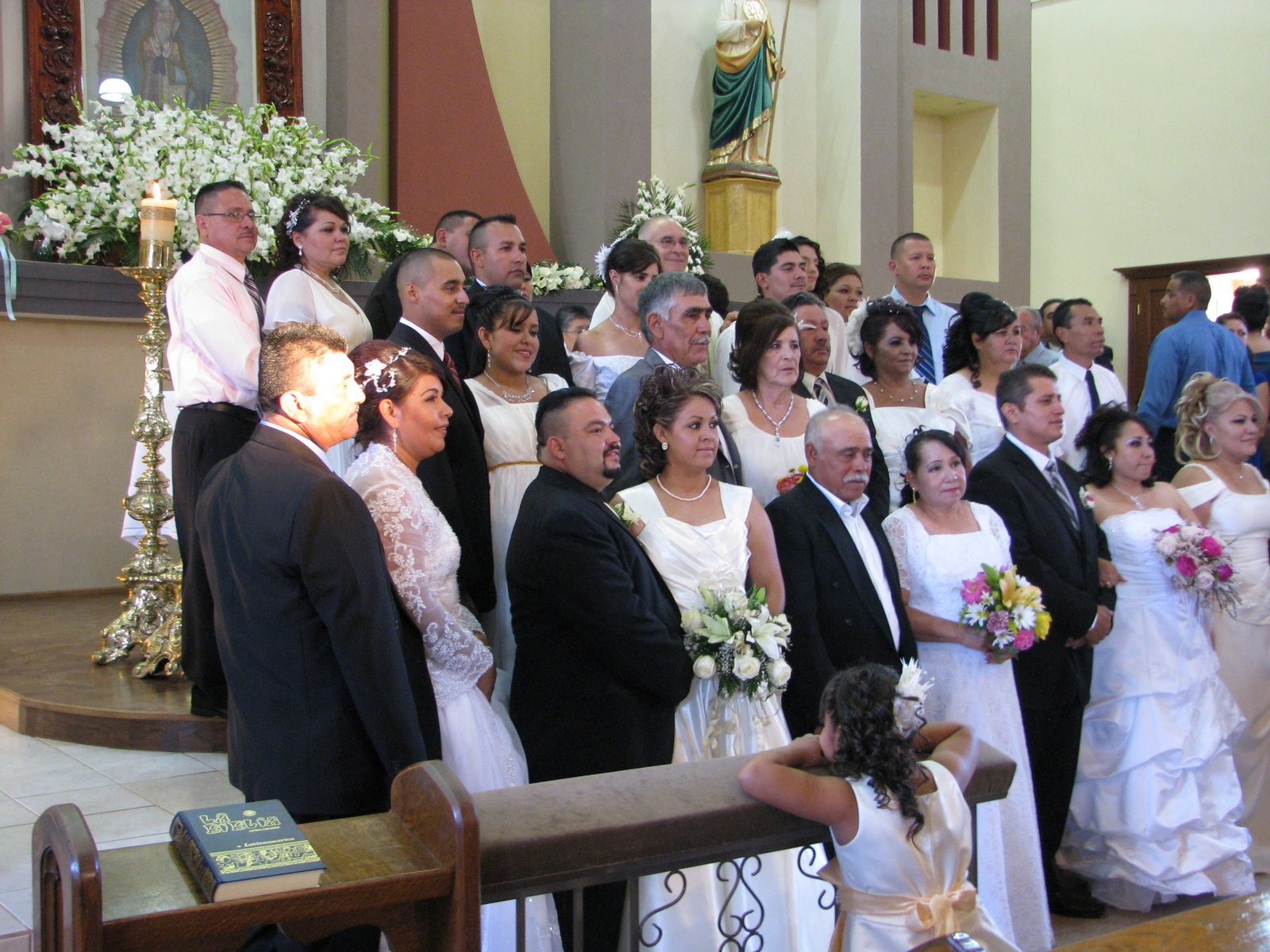
The newlyweds turned at the back of the church, walked down the second aisle and back to the front for group photos.
Newlyweds
Eventually, all the picture-taking was done and the couples and families went out the side door for a little brandy with the priest. The rest of us headed to the reception.
Lupita and my other friend, María, shared the reception – after all, there aren’t that many nice places for receptions in Naco, and fourteen couples wanted those places.
The minute the music started, little kids hit the dance floor. I groaned when I saw girls as young as five wore heels an inch or more high.
Little heels.
Eventually, the adults began to dance, too. First the brides and grooms, then others.
We all had barbacoa, beans, and macaroni salad. Beer and wine flowed.
A great wedding, a wonderful reception, and a beautiful, beautiful bride.
I am not a winter person. That said, I love when winter arrives because it enters on the wings of sandhill cranes.
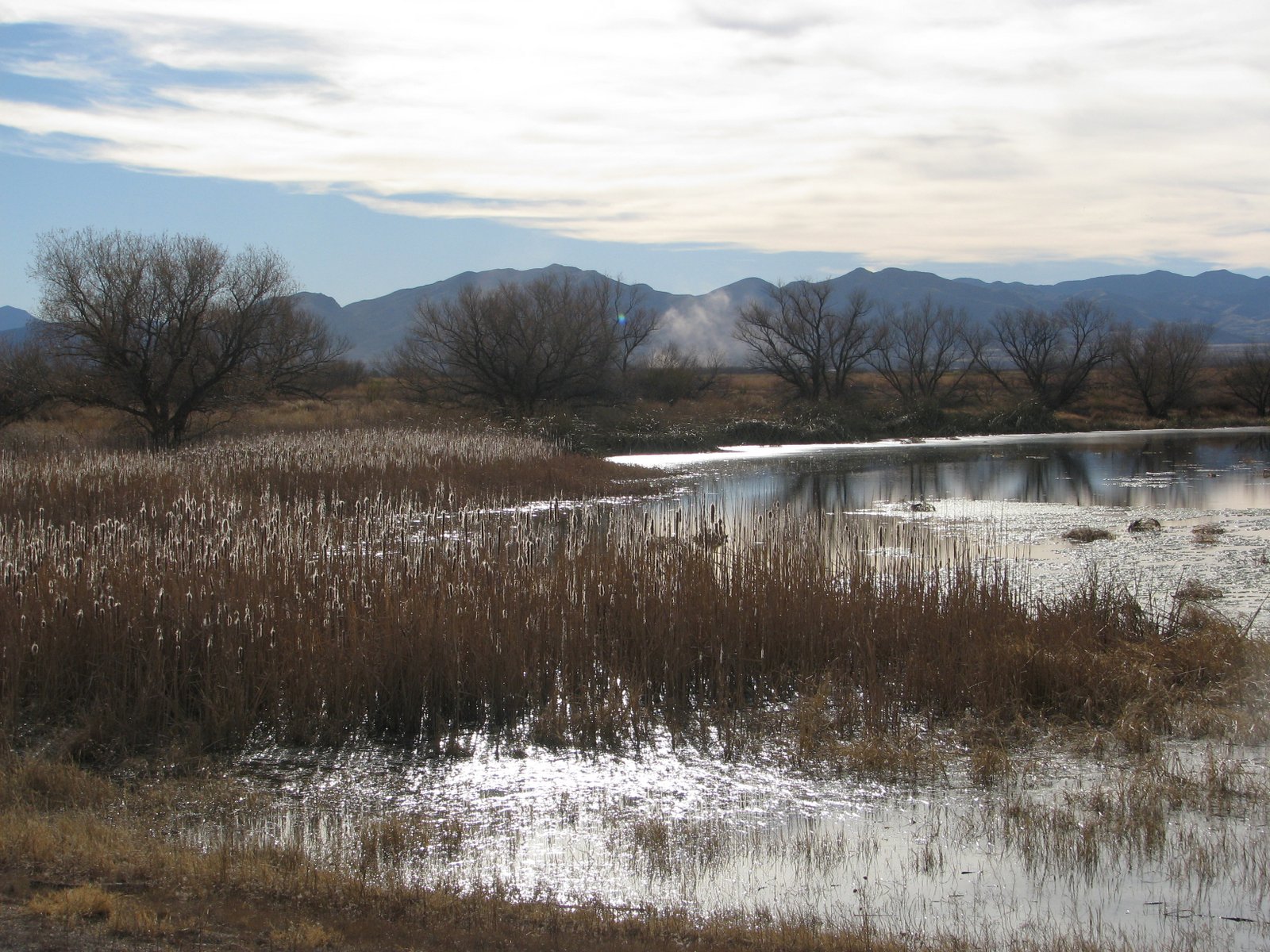
Each October, the cranes begin to settle in at Whitewater Draw. On a good year, there can be over 30,000 of them, but the record is nearly 45,000 in 2010.
The first time I visited, I filled my thermos and headed out before dawn. I wanted to watch as they lifted off and headed north in search of corn and other grains.
Whitewater Draw, near Elfrida, Arizona
But they fooled me. I stood there in the pre-dawn, shivering in layers of socks and down. I listened as they discussed their day, and then whoosh! Whoosh! Whoosh! Off they went, before daylight. All I eventually saw was a few stragglers who took off in their own good time.
Since then, I’ve learned that it’s better to go out in mid-day. First of all, it’s warmer. I don’t have to bundle up as I did as a five-year-old headed out to play in the snow. Also, I can take a book, a blanket, and a small picnic.
I can stay for hours, alternating between sun and shade, reading and walking.
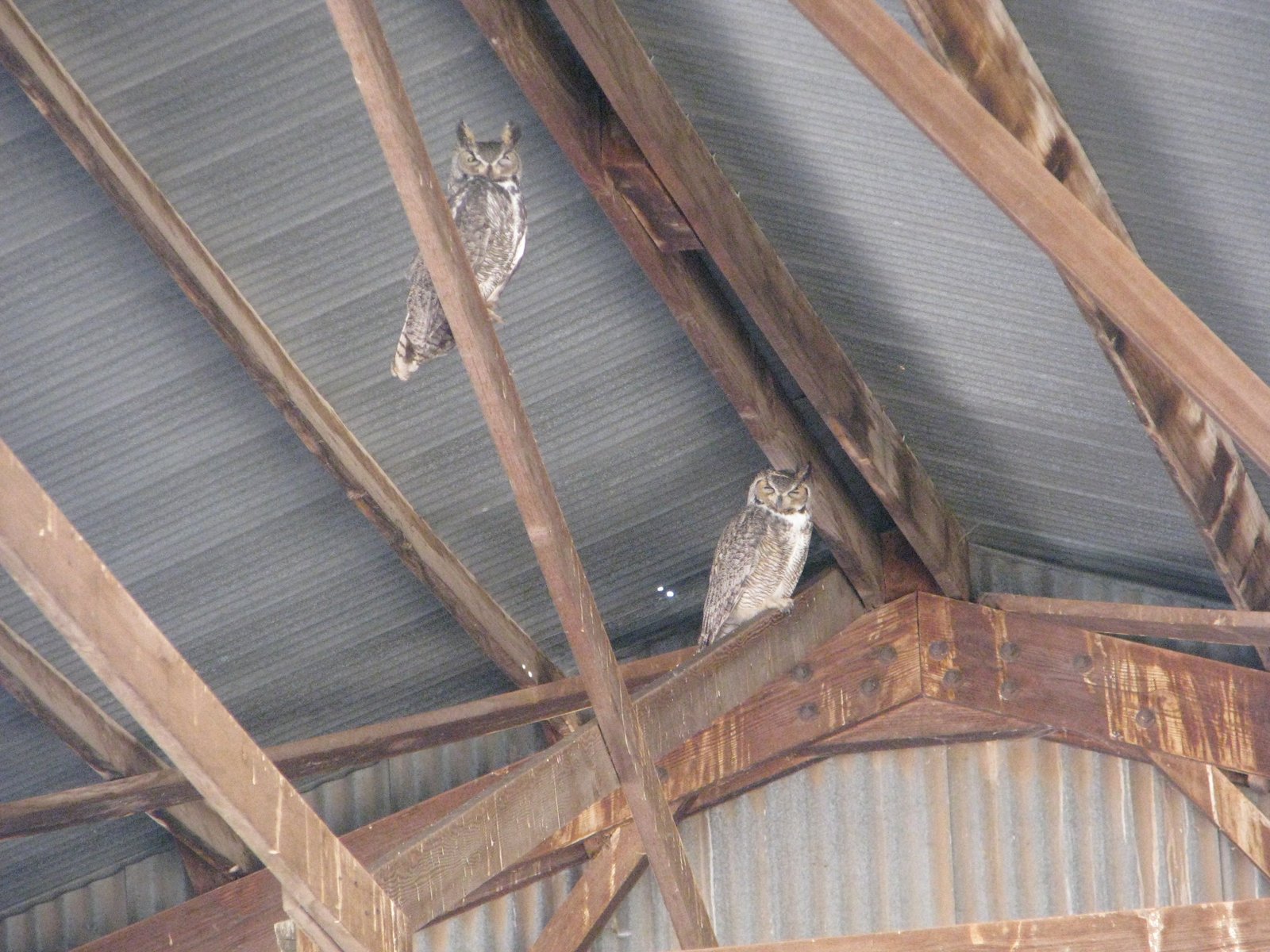
On an especially lucky day, I can also catch an owl or two at the Draw
But the best part, of course, is the cranes themselves. There are six subspecies of sandhills, and two of them winter here. I believe they’re the Greater and the Canadian. The Greater is, well, greater, and can be as tall as five feet. The Canadian is shorter, sometimes topping out at only three and a half feet. But some of the Canadians are a bit taller and some of the Greater a bit shorter, and from the distance I see them, they appear the same.
The cranes spend the morning cleaning out corn fields and begin to return to the Draw in early afternoon – fifty, eighty, one hundred at a time. A distant speck in the north becomes larger, longer. Soon it’s a line of cranes, zig-zagging across the sky, swooping up and down, and eventually circling the water and touching down without a splash.
A line of cranes flies in.
They spend the afternoon chatting, taking off in small groups to cruise the Mule Mountains, and returning again. The sound of thousands of cranes chatting is remarkable.
I’ve celebrated Thanksgiving and New Year’s Day with the cranes. I’ve gone alone and stayed apart from others. I’ve also gone for lunch with friends and to celebrate a birthday.
Even now, early September, I’m longing for winter days and time with the sandhills.
It was difficult to leave T or C. It always is. But we got up early and took a good soak.
Three of the pools at Riverbend. The first is the hottest as that’s where the water comes in. Oh, it feels so good!
Then we bypassed the Happy Belly Deli and went to a new place called Passion Pie Café.
Downtown Truth or Consequences on a busy Friday morning.
I won’t tell you what I ate, but it contained enough fat and cholesterol for a week. Debbie ordered The Elvis, because she read the name but then read the wrong description. She calls it her Once In a Blue Moon Breakfast: waffles with peanut butter and bananas, topped with whipped cream. Where was Cinda the whipped cream junkie when we needed her? The Elvis looked pretty awful to me, but Debbie said it was actually good, though she might not be ready for another one until the next blue moon.
The Elvis.
Then a sad goodbye to Riverbend and the Rio Grande. We took a back road back down to Hatch where the chile festival http://www.hatchchilefest.com/ was in full swing. We got out fast, bypassing the Dead Kennedy Café and headed into Las Cruces on back roads.
We took a quick visit to the Mesilla Valley Bosque State Park where it was too hot to wander the grounds, then checked into a motel. Soon I was off to White Sands.
A detour. Another friggin’ border patrol checkpoint. A major wreck. But I got to the park around 5:15. It was too early, and in a sense it was too late.
Too late, because to get good photos, it’s good to know the park well. I needed a day to explore, find the right dune, and really know the area. Too early, because it was quite hot still, too hot to wander the dunes.
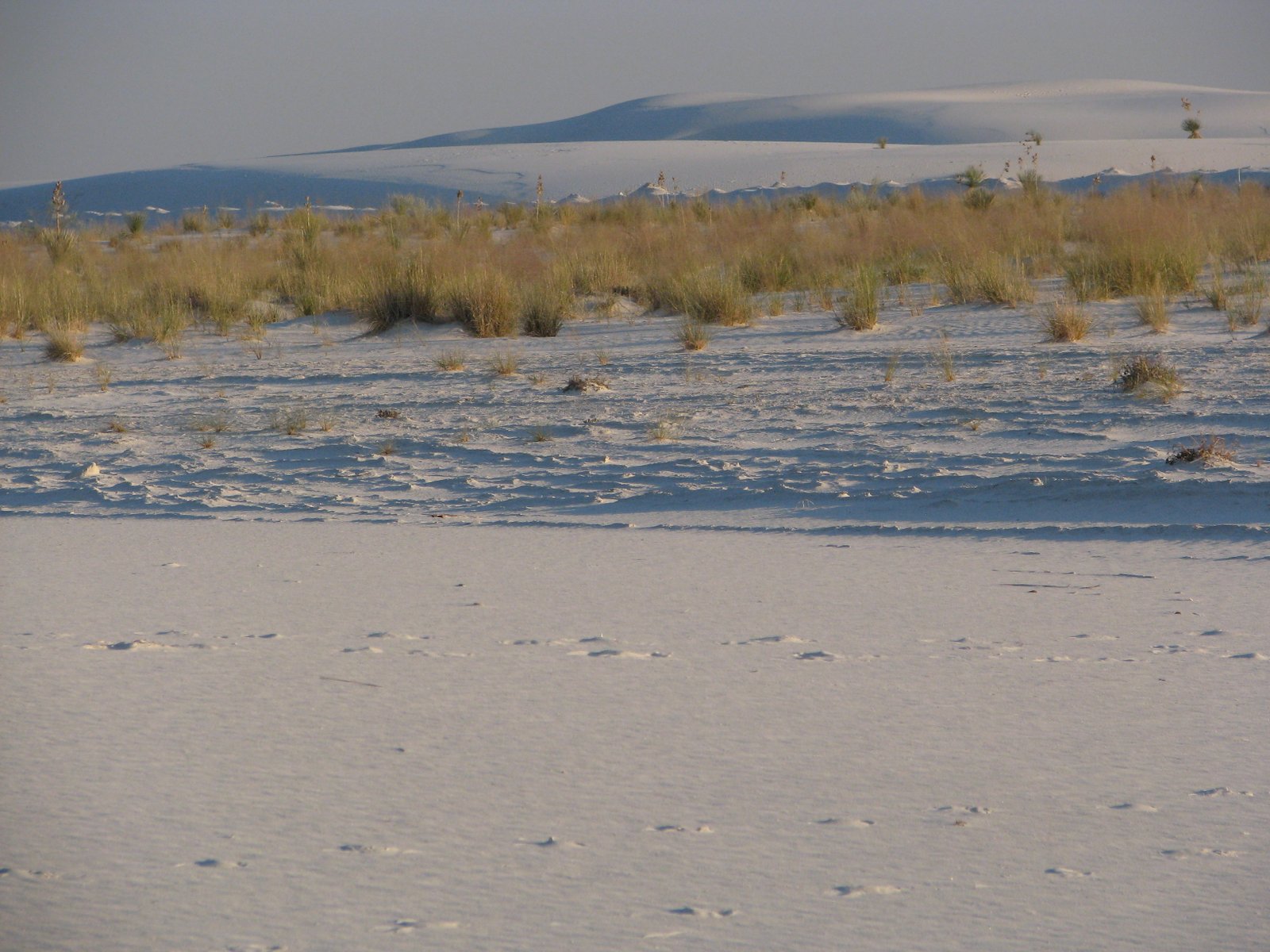
I drove the whole area and finally found a spot that would work. Not many people, not too many footprints in the sand, close to the road. I didn’t want to hike back to the car after dark.
I grabbed my camera, tripod, and water and got set up over an hour before sundown. I walked a bit but mostly hid in the shade.
People arrived. More people arrived. And then still more people arrived. I swear, thousands of people showed up for this moonrise. Streams of cars full of moon seekers came down the road. But miraculously, most drove on past, and almost all who stopped wend the other direction from me.
I began to set up the camera and tripod. DISASTER! The tripod didn’t fit the camera! I couldn’t believe it. A tripod’s a tripod, right? I have used it on other cameras in the past. But without getting technical, just believe me, the camera didn’t fit on the tripod. I had to resort to lightly balancing it on top. The result is lots and lots of fuzzy photos.
I am heartbroken. But then the silver lining: I have to come back!
The crowds of people were talking and laughing, and the whole thing was much too raucous for me.
A portion of the raucous crowd. They were having a ball “sledding” down the dunes.
And then the moon peeked over the mountains. Everyone went quiet. Loud teenage boys, crabby old ladies, and shrieking children fell silent.
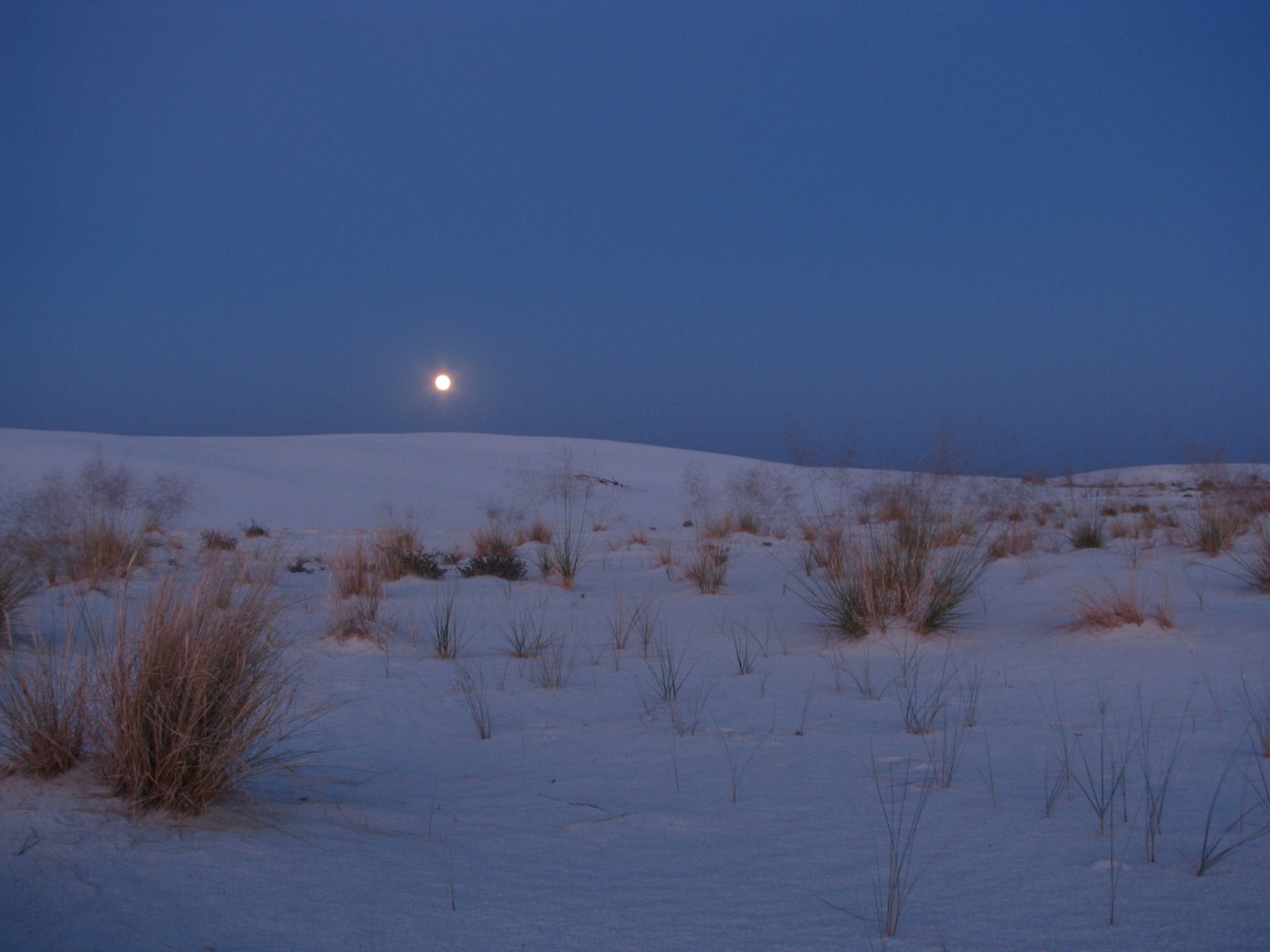
She rose golden, slipping into silver as she climbed the mountain.
I don’t have words to capture the beauty and reverence that filled the valley. Truly the best moonrise and one of the best moments (barring tripod disaster) of my life.
Still, I got a few good shots.
And now I know a few good places for photos and as a bonus I have my new free Senior National Parks pass!
Willie’s song rolled around in my brain as Debbie and I took off for a little two-day jaunt to New Mexico. We cruised up Highway 80 and hit the state line where the speed limit dropped by five mph and New Mexico’s daylight savings flipped us an hour ahead.
I gotta say, one of the things I love about Arizona – and there are fewer things that I love about it each year – is we don’t do daylight savings time. We leave the clocks alone. No setting them ahead and then back. The only time I have to mess with my clocks is after the power outages that accompany our monsoons.
So. Up Highway 80, pit stop at the welcome center in Lordsburg and a fast stop for gas in Deming. Blessings upon gadbuddy.com for telling me we’d save a dime a gallon by getting gas there rather than in Lordsburg.
North, then northeast along that wonderful cutoff – commonly called the Hatch Highway – that takes us past the town of Nutt and into Hatch.
I hadn’t been on this road for awhile and there were three big changes. First was the new border patrol checkpoint. Now, these checkpoints annoy me anyway, but I was even more upset than usual to find one on this road. Most checkpoints are within twenty to thirty miles of the border (they are supposed to be within twenty-five), but this one was at least forty miles in.
A young man approached our car. Well, he didn’t quite approach. He was dragged by a large overanxious drug-sniffing dog. The young man was polite and the dog looked like he was ready to leap through the car window so he could slobber my face with doggie kisses. The dog evidently smelled no drugs, and the boy-agent evidently believed we were US citizens, so we were sailing down the road again in just a moment.
A short while down the road, right near Nutt, was the second surprise. A wind farm! Oh, it was beautiful. I love the grace of these slow moving giants. About thirty of them here, blades spinning lazily in the light breeze. I wondered what they would look like during a hurricane, spinning madly and sending blades flying. Now, this is just a mind game. I know they have braking systems that shut them down when winds get above 45 or 50, but with Isaac hitting New Orleans and surrounding areas, suddenly the picture wasn’t so pastoral.
The third surprise was that a little beyond Nutt was a solar farm! Though not as beautiful as the wind farm, it was still a lovely sight. Neither power plant had a haze of pollution. Neither made noise. Unlike nuclear power, there will be no spent rods that will have to have armed guards for the next thousand years. These two systems simply sat there producing electricity. Cleanly. Quietly. The rural west has plenty of space and an abundance of sun, with wind as a bonus. With the millions and billions of tax breaks the oil and coal and nuclear fat cats have received over the years, surely it’s time to channel some funds into wind and solar.
Finally we got to Hatch. Hatch! The chile capital of the world. And the town, population well under 2000, was gearing up for its annual chile festival. The airport had already turned into a fairground. The ferris wheel was up. By Saturday thousands would be making the annual pilgrimage to Hatch to buy a sack or two or more of fresh roasted green chiles. We didn’t escape town without our fair share.
But the real highlight of Hatch is the Dead Kennedy Café. No, it’s not the real name, but it’s been my name for it since the first time I set foot in the door.
One of the locals kept making Debbie laugh as I tried to photograph her with the Kennedys.
The Valley Café holds seven tables and three stools at a counter. It serves up some great Mexican food including the best huevos rancheros I’ve had anywhere, including anywhere in Mexico. The huevos aren’t anglicized at all. The first time I tried them, I looked at them in disbelief. Took my first bite, then exclaimed to the waitress, “This is like the huevos I get in Mexico!”
“Is that good?” she asked me timidly.
I gave her a huge grin. “Absolutely!”
I dove into my huevos then, and now I try to get them any time I pass through before noon or so.
The café is small, and mostly it’s locals who eat there – just the occasional passer-by. During the chile festival, though, I suspect it will be mobbed. The walls hold a few Mexican decorations, a few cute saying in both Spanish and English, and a small collection of photos of John Deere tractors. And a portrait of Jack and Jackie.
When Debbie first saw it, I thought she was going to go out of her mind. She’s a practicing Catholic. Irish, and from Boston. Jack and Jackie! Every house in her neighborhood used to have that very portrait when she was young. And here we were in downtown Hatch, and there was a 1960s portrait of the Kennedys on the wall.
The Dead Kennedy Café. Eat there if you’re ever in Hatch, but look for the name Valley out front.
After lunch, we continued on to Truth or Consequences, the smell of fresh
View from one of the pools
roasted chiles permeating the car. First stop – the Paws and Claws Thrift Store. Thrift store stops are mandatory if Debbie is in the car. We picked up a few items and checked in at the Riverbend, one of my very favorite places to stay. Anywhere.
Riverbend sits on the banks of the Rio Grande and has five hot pools overlooking the rolling waters. The motel used to be the best. It was affordable and funky. But now they’ve gone more upscale, and the prices have too. They’ve pretty much priced me out of staying there. It’s an occasional splurge instead of a biannual pilgrimage.
Virgins in the garden.
And I preferred the funkiness. It has kept some. There’s still a Buddha in one corner of the garden and two Virgin strewn with Mardi Gras beads in another. Sculptured geckos still crawl the wall. But it’s all been paved and gussied up outside, and now there are gates in the wall, and patrons are issued keys. There’s a new patio with nice lounge furniture, and the old grill has been replaced with a $500 model. And the rooms have been redone.
The feel isn’t as welcoming and laid back as it used to be. Oh, the people in the front office are still friendly and helpful, but the whole feel is different.
There’s a teepee here. It sits right along the river and is outside the wall to the guest rooms and pools.
Moonrise over Turtleback.
I used to sit on a little bench in front of it and gaze at the river. The owner has now extended a wall so passers-by can see the teepee, but the wall cuts off the river view. Can’t have people enjoying his view without paying, I guess.
But we spent the night, spent too much money. Hit Bullocks grocery store in addition to the Paws and Claws. Sat by the river and soaked in the tubs. Watched the nearly full moon glide up over Turtleback Mountain. And it was lovely.





























 Emilie Vardaman